Thursday, December 31, 2020

Star Trek: Discovery - There is a Tide... Review

DIS "There is a Tide..."
Being barefoot was the clincher. If it wasn't clear before: with Burnham running loose on the Emerald Chain-controlled Discovery, limping but determined, shielded by the powers that come only from being a regular character on a TV show, she spaces a "Regulator" who pulls off Burnham's shoes while trying to hold on for dear life. So this is Burnham's Die Hard. It's territory Star Trek has trod barefoot on before; "Starship Mine" on The Next Generation was Picard's go at the story template. In place of Hans Gruber and his non-negotiable bearer bonds, we have Orion space pirate capitalist Osyraa, in a suspenseful episode that sets the stage for next week's season finale.

What primarily defines "There is a Tide..." is a desire to flesh out Osyraa as a villain. She's come to UFP headquarters to negotiate entry into the Federation, in a seemingly genuine desire to pool resources and in the spirit of compromise. Through the scientist character Aurellio (played by frequent Discovery guest star Kenneth Mitchell), we are invited to understand why a rational person would follow Osyraa. 

By way of contrast, everything Burnham does in the episode is siloed off from these complications introduced to Osyraa, so it's quite a "by any means necessary" situation for Burnham (including forcing Stamets off the ship to take the spore drive out of the equation. This invocation of high drama and character conflict is half-successful; it works on the performance side, but doesn't quite pop on the story side). Indeed, even Aurellio is forced to face the unsavory ruthlessness that is undeniable in his boss. 

Negotiations between Osyraa and Admiral Vance break down when her assumed immunity from criminal prosecution is off the table, and from the look of the next time trailer, Osyraa's wrath seems to regress her from the overtures she made in this episode. She claims to represent the interest of her people, but baulks when her own interests are put into perspective. The overall picture of this character arc lacks a clear hook or throughline. While Osyraa can appear forthright and rational, she's essentially doing all this with a gun to our main characters' heads. Her past crimes, and those on her watch, speak for themselves.

While the episode tries to introduce more shades of grey to the green Osyraa, it checks off the truly hissable villain box by bringing back Zareh, last seen in "Far from Home". The bridge crew is held hostage in the ready room, but pro tip: maybe assign more than two guards to the only prisoners you've got. At episode's end, the Sphere data from Discovery's computers, which has apparently migrated to the repair robots, offers its services to Captain Tilly. "There is a Tide..." splits its time between retaking-the-ship action (more of which is promised in the finale) and the refracted Osyraa/Emerald Chain characterization. The episode sets out to make the season's main villain more than a space pirate, which only partially comes to fruition. 6/10.

Stray observation:

- One of Trek's old hack moves was always to compare something to an exotic alien animal, like for instance, "That drink had more kick than an Aldebaran bandicoot!" Admiral Vance pulls out, "like an Altarian spider". That type of line used to be so common in 90s Star Trek, and now it's kind of comforting to hear.

Wednesday, December 30, 2020

Star Wars: The Mandalorian Season 2 Overview

Star Wars: The Mandalorian Season 2

Average episode rating: 7.4/10

No one expected Baby Yoda. The reveal at the end of The Mandalorian's first episode, utilizing the same silhouetted-ears-from-behind shot that heralded Force ghost Yoda's appearance in The Last Jedi, was blindsiding. While hints were in the air that the titular character would come to protect a young charge (the Lone Wolf and Cub setup), the reveal redefined the conception of the show from a notional bounty of the week structure to odd couple domestic adventure.

By making the Child Yoda's species, the reveal also tied into the larger Star Wars mythology, a project that the second season expanded with many tendrils. With an ear to the ground, appearances from Boba Fett, Bo-Katan Kryze, and Ahsoka Tano came as welcome developments but not surprises. But Luke Skywalker and R2-D2 were shocking cameos, at least to me.

Spinning out of the first season, a quest to find the Child's (now Grogu's) kind was interpreted by most to be a search for other members of Yoda and Yaddle's species. But Season 2 reoriented that, avoiding demystification via a planet of the Kermits by defining Grogu's "kind" as another Jedi. And in a painful, poignant scene, Din said goodbye to Grogu, leaving him in the charge of Luke. For my part, I am prepared for and content with Grogu never appearing on the show again, but it also seems unthinkable that part of what defines the show as a piece of drama and a cultural phenomenon will never return. But I remain open to either cold turkey removal of Grogu for good, or an eventual reunion.

The show's portrayals of both its Jedi characters, Ahsoka and Luke, skewed toward the reverent, like these were mythological figures and not flesh and blood people. Not that there weren't precious dewdrops of characterization from both, but the show itself reacted to them, especially Luke, with a certain depersonalizing awe. Luke never names himself; he represents the legend of the Jedi. The episode in which he appears is called "The Rescue", and Luke's rescue here is quite a contrast from A New Hope's "I'm Luke Skywalker, I'm here to rescue you!"

The build-up to his appearance is kicked off by the arrival of his iconic X-Wing. This continues the mythologizing of that craft, particularly in The Rise of Skywalker. Rey leads the Resistance to Exegol in that fighter and is recognized over sensors with, "That's Luke Skywalker's X-Wing." In a moment of jubilation, Finn exclaims, "Red Five is in the air!" In that same movie, we see a de-aged Return of the Jedi-era Mark Hamill face on a body double, showing that The Mandalorian is not the first Star Wars project to make that move.

These big character reveals may dominate the headlines, but to the show's credit it also brought back guest stars from Season 1 for further development. While Greef Karga only featured in one episode, Cara Dune and Fennec Shand's roles expanded, and minor characters like the Mythrol and Q9-0 came back with a new spin on their characterization. (Peli Motto came back much the same!) The poster child of this character rehabilitation was certainly Migs Mayfeld, a fairly generic rogue in Season 1, a likable, almost wise antihero in Season 2.

Season 2 saw composer Ludwig Göransson incorporate past Star Wars music into the show for the first time: From Kevin Kiner, Ahsoka's theme. From John Williams, Yoda's theme, the Star Wars theme, and the Force theme.

There was also acknowledgement of some of George Lucas' foundational influences when creating Star Wars, namely Akira Kurosawa movies and Frank Herbert's Dune. Lucas mentee Dave Filoni framed Ahsoka as a ronin samurai Jedi, using shots taken from Yojimbo and Seven Samurai. The town in that episode was called Caladan, a name from Dune, and the spectacle of a krayt dragon was extremely reminiscent of a sandworm.

Season 2 followed the "bigger and better" paradigm, making for a fine companion piece with Season 1. As the show goes on, it must redefine what the show is yet again. All the Mandalorian lore was a sideshow in the end to the bond between surrogate father and son. What is the show now? I'm fascinated to find out.

Elements from Star Wars canon depicted in live-action for the first time in The Mandalorian Season 2:

- Cobb Vanth, from the Aftermath novels

- A live krayt dragon

- Temuera Morrison lending more than his voice to Boba Fett

- Bo-Katan Kryze

- Dark troopers

- Ahsoka Tano

- A convor (space owl)

- Mandalorian dagger ship

Top 5 moments:

5) Jon Favreau restages Cowboys & Aliens vs. a krayt dragon, "The Marshal"

4) Mayfeld shoots first, "The Believer"

3) Ahsoka Tano vs. Morgan Elsbeth, "The Jedi"

2) Luke's arrival/goodbye to Grogu, "The Rescue"

1) Armored Boba Fett jets down into the fray, "The Tragedy"

Thursday, December 24, 2020

Star Trek: Discovery - Su'Kal Review

DIS "Su'Kal"
Doug Jones has always been primarily known as "the monster guy". From the Faun in Pan's Labyrinth to the Amphibian Man in The Shape of Water, he brings a beguiling choreography to his characters. He even played an FBI agent turned into a human carrot in The Adventures of Rocky and Bullwinkle! Saru has been a plum role for Jones, as he's developed a cohesive physical and emotional characterization for the character, who's even risen to the rank of Captain. Through a quirk of storytelling, "Su'Kal" offers Jones the chance to play Saru without Kelpien makeup. It's an unexpected move on the part of an episode that offers surrealism on the one hand and a sense of real peril on the other, as Discovery enters the season's endgame.

Saru, Burnham, and Culber beam down to the source of the Burn-related Kelpien distress call, and are immediately wrong-footed. The landing party has inexplicably seemed to switch species; Culber is Bajoran (complete with spiritually significant earring), Burnham is Trill, and Saru is human. The episode takes on the contours of a fairy tale, Burnham as a Trill red riding hood in a wintery forest - and beware the grim, unchained monster.

The episode's surreal touches, such as an Escher-esque maze of stairs, depict a large-scale holographic environment tailored to an emotionally immature Kelpien, alone on a planet made of dilithium for over a century. Given the Kelpien Su'Kal's culture, the program takes on tropes of Kelpien folklore meant to scare and educate children, a scenario that Saru ironically faces with the unvarnished face of Doug Jones.

It also comes out that when Su'Kal was a child, his emotional distress caused the Burn. In a way it's a twist on past Trek storytelling featuring childlike god-beings whose tantrums have galactic consequences (such as Trelane in the original series).

On Discovery, Tilly is in command. Burnham gives her a nice speech about an imperfection in the metal on an arm of the captain's chair that Tilly can use to ground herself, and Tilly certainly comes to need it. While she adapts to the responsibility of the chair with a commanding, competent affect close to monotone, Osyraa and her big spiky ship arrive and after a stand-off, board Discovery and claim the ship, along with its spore drive. Meanwhile, Book rescues Burnham, but stowaway Adira joins the remaining Saru and Culber to deal with radiation poisoning, and the emotional state of the orphaned Su'Kal.

So a sense of peril raises the stakes, going into the final stretch of the season. The episode is, as Book would say, a "game changer" (apparently a phrase that survives to the 32nd Century). It's also animated by its manufactured children's picture book setting, finding the show getting agreeably weird. 7/10.

Sunday, December 20, 2020

Star Wars: The Mandalorian - The Rescue Review

MND "The Rescue"
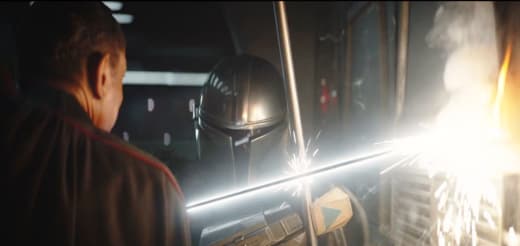
The season 2 finale of The Mandalorian has an outsize connection to the larger Star Wars canon, to an awe-inspiring extent, in fact. Crucial developments shed light on the rightful rule of Mandalore (Bo-Katan is back, gunning for the darksaber that Gideon took as a spoil of genocide), the state of a new Luke Skywalker-shaped (!) Jedi order, and even the power vacuum left by Jabba the Hutt's death (Boba Fett and Fennec Shand move right in with an efficient power play).

None of that matters to Din Djarin.

That's how all these planet-shaking story points are held back from overshadowing the heart of this show. Din is here not as a Mandalorian, not as a child of Death Watch, not as a bounty hunter, not as a "Ranger of the New Republic" come to arrest remnant Imperials, but only as a father.

Even his precious Creed matters not, if it keeps him from showing his face to his son, and making that last humanoid connection, before sending Grogu with Luke. There stands Luke: the man who destroyed the first Death Star, founded Rogue Squadron in honor of Jyn Erso and company's sacrifice, and turned the monolithically evil Darth Vader back to the light side of the Force. But all Din needs to know is that Luke can help his son. And so, like Leia later will with her son Ben, Din places Grogu in Luke's care, to train as a Jedi padawan.

From a filmmaking perspective, the Luke reveal is firmly in "the Legend of Luke" territory. Almost angelic in his implacable power and serene facade, there's no interest in humanizing details. Appropriate for the context of this episode, his status as Jedi is almost unknowable.

Taking a step back from the luminous beings stuff, Din attacks Gideon's cruiser with an all-female strike team, including the returning Bo-Katan and Koska Reeves. (Amusingly, Bo-Katan taunts Boba Fett for being a clone, like the Republic clones she once fought alongside.) While Boba Fett creates a plausible cover story for boarding, the three Mandalorians plus Fennec and Cara Dune run up against Gideon's elite Dark Trooper droids. Like something out of The Black Hole, or akin to original Battlestar Galactica Cylons (fitting given Katee Sackhoff's presence), the Dark Troopers are a potentially overwhelming threat that Luke eventually extinguishes.

Throughout the episode, composer Ludwig Göransson simply goes for broke. When the title of the show is thrown up, a pumped-up version of the main theme plays. The Dark Troopers are given an ostentatious metallic techno riff. And even the reveal of a TIE Fighter makes the little unshielded fighter seem like the stuff of nightmares. During Luke's scenes, a redressed version of the main Star Wars theme airs, plus a fairly straight quotation of the Force theme.

Din finds Gideon guarding Grogu, and the two duel, beskar spear against darksaber, until Din is victorious. But like the Elder Wand in Harry Potter, the darksaber can only be claimed by besting the owner in combat, foreshadowing a future conflict between Bo-Katan and a disinterested Din.

There are a lot of elements to this episode that after all is predominantly a propulsive piece of action. And while darksaber lore and especially a visit from Luke and R2-D2 are huge deals to fans, the episode's trick is that in Din's headspace, he has a singular parental goal. He has made safe Grogu and delivered him to a willing Jedi. Doesn't make Din's tears sting less. 8/10.

Stray observations:

- Boba Fett doesn't strike me as the type to sit on a throne, but there he and Fennec are, fresh from a spot of Bib Fortuna-murdering, taking up residence at Jabba's Palace.

- One of the Imperial shuttle pilots canonizes the old Clerks joke about "the contractors on the Death Star". He's played by Thomas E. Sullivan, who also played the villainous Nathaniel Malick in Agents of S.H.I.E.L.D., featuring Fennec Shand actor Ming-Na Wen.

Friday, December 18, 2020

Star Trek: Discovery - Terra Firma Part 2 Review

DIS "Terra Firma Part 2"

"Terra Firma Part 2" is an episode with a laser focus on Georgiou's character that stands on the shoulders of giants - specifically, two iconic Star Trek episodes. We'll get to what those two episodes are. But the headline is that after Part 1, which surrounded Georgiou with the posturing nastiness of the Terran Empire and only at the end set up the shape of the story, Part 2 finds Georgiou and the show working toward constructive goals.

Georgiou's goal: to try, with a remarkably earnest line in monologues about a shining Federation in place of an Empire, reshaping the Empire and her daughter Michael Burnham into something humane. Good luck!

The show's goal: to send off the Georgiou character from the show, highlighting her personal growth and setting her up for a potential spinoff.

Georgiou's attempts to reform Burnham are doomed to fail, but a convincing veneer of progress is made, with touching motherly anecdotes, and yes, also copious amounts of torture and entreating Burnham to execute conspirators against the throne. Building on her bond with Saru in Part 1, Georgiou also blows his mind with knowledge that reframes his entire understanding of Kelpien life.

In the end, it's revealed that the entire experience was an exercise, a test of sorts within Georgiou's head, to weigh the scales of her soul. It's a logical twist, and in fact the only way to make this backward-looking story work. Georgiou lived a crucible of several months in the span of a minute or so, aligning her experience to Picard's in "The Inner Light".

It's also revealed that the mysterious Carl with his metaphysical door is none other than the Guardian of Forever. In my review last week, I called Carl and the door "a workaday Guardian of Forever", which was not so much a prediction but an observation. But taken as prediction, it paid off! (There is also a hint of tragic future backstory for the Guardian, who was abused by bad actors during the Temporal Cold War.) So "Terra Firma Part 2" gives Georgiou "The Inner Light" experience and "The City on the Edge of Forever" treatment. (Not to mention "Mirror Mirror"...)

The episode's main business is lowering the curtain on Georgiou's time on Discovery, sending her back to a time when the Prime and Mirror Universes were more closely aligned (read: original series time). And so the episode ends with a touching toast to what Georgiou meant to the crew and the show. A Michelle Yeoh-less Discovery is not a joyful thought, but the show closed the door on her well. 7/10.

Stray observations:

- In one of her scenes with Saru, Georgiou wears a blinding gold robe like she's Supreme Leader Snoke himself. Another Star Wars villain connection: last week she said, "Long live the Empire", which Moff Gideon was heard to say just a few weeks ago on The Mandalorian.

- Look at Georgiou being all Shakespearean and using the word "orison".

- Title sequence is upside down, get it?

Wednesday, December 16, 2020

Power Rangers Season 27 Overview (Beast Morphers)

Power Rangers Season 27 (Beast Morphers Season 2)

Average episode rating: 6.4/10 (holding steady from Season 26, Beast Morphers' debut, with 6.3/10)

The Hasbro era of Power Rangers has gotten off to a solid start with two seasons of Beast Morphers. At least some of the goodwill toward this team might be due to where we just came from. The Neo-Saban era is unequivocally the worst in the show's long history; Dino Charge is the only genuinely good incarnation it produced, with the follow-up Ninja Steel slipping on a banana peel week after week. But even divorcing Beast Morphers from the context of looking good by comparison, it still stands out with its attention to detail, mostly solid character development, bursts of creativity, and an on-point cast.

Its second season, Power Rangers' 27th overall, also made the fan-pleasing decision to embrace more continuity. So main villain Evox was revealed to be a mutation of RPM baddie Venjix, Doctor K showed up as a guest mentor a couple times, and of course, a dinosaur-themed team-up event made a huge noise even if it sacrificed some elegance to do so.

At the end of Season 26, the original digital avatars of Roxy and Blaze were defeated, freeing their human selves from comas. Going into Season 27, the potential of these characters seemed limitless. Here were two people who had been intensively trained to be the Yellow and Red Rangers. They could assist the team in any number of ways, including in unmorphed fights or even, if the show felt ambitious, as sixth and seventh Rangers.

But that is not even close to the direction the show took, to its cost. Roxy and Blaze were retained as robot villains in addition to their human bodies. I get it. Colby Strong, and especially Liana Ramirez, give excellent arch-villain performances. But human Blaze, whose spiky personality caused friction at the outset of this team, had a personality lobotomy that made him 100% docile and inoffensive, to the point where Blaze evincing a dissenting opinion meant he must be the robot in disguise. The gaping missed opportunity of using human Roxy and Blaze as secondary team members or Grid Battleforce allies is the single biggest demerit on this season.

But evil or not, Roxy and Blaze are assets in this cast. Ben and Betty were sometimes assets as well, and sometimes victim to the same Wile E. Coyote logic that animated, God help us, Victor and Monty in Ninja Steel.

One area in which this cast excels is roles for women. There is a female Ranger (Zoey), a formidable mentor (Commander Shaw), a deliciously evil villain (Roxy), and broad comic relief (Betty), all appealing. That's all four quadrants! The only other season to match it in all four "quadrants" is Dino Thunder: Ranger (Kira), mentor (Hayley), villain (Elsa), comic relief (Cassidy).

While still prone to wonky Saturday morning logic at times, Season 27 is a success, and Beast Morphers overall is a hopeful sign that the Neo-Saban era's low standards are banished. Next on Power Rangers: Dino Fury. 

Saturday, December 12, 2020

Power Rangers Beast Morphers: Evox Unleashed Review

PRBM "Evox Unleashed"
What "Evox Unleashed" nails as a season finale, and finale to a Ranger team's story, is an "end of term" feel, wrapping up a number of small but important threads. In doing this, it touches the emotions to a surprising degree, making up for slight deficiencies with the action portion of the episode.

Yes, Venjix/Evox is gearing up for a final power play, but there are human stories to attend to, even in the midst of a Coral Harbor evacuation. In a touching scene, Zoey reveals that she's the Yellow Ranger to her mother (and now, all three original Rangers are "out" to their parents). Even when the situation is desperate, Ben and Betty resolve to stay and help the team. And this is a wonderful episode for Commander Shaw. She authorizes Zoey's disclosure, and Shaw gets one of her best moments in a pep talk to the team about the power of being human. The speech is blunt, efficient, and composed, and I expect nothing less from her.

And another favorite end-of-season trope: morphed Rangers with their helmets off! 

With Venjix having adapted to Grid Battleforce weapons, the Rangers try using various pieces of legendary Ranger arsenal, but despite their best efforts, Venjix appears to kill Steel. Down a Ranger, the team comes up against Venjix' giant evil mech, appropriately looking like a bastardization of an RPM zord. Zoey tells us this is "50 times bigger" than a gigadrone. That seems like quite an exaggeration. It's maybe twice as big?

In a clever turn, the Rangers figure out a way to literalize their human advantage over Venjix. Using examples from earlier in the past two seasons, they figure out that Venjix' Evox form is incompatible with human DNA, and that animates their final blow to the cyber-villain. Impressive as that is on a storytelling level, the biggest issue with the episode is that the fight with Venjix himself is not dynamic. They shoot at him, it doesn't work, Steel tries to shoot him, it doesn't work, Venjix kills Steel with a wave of his hand, Venjix gets big, Rangers stab him, job done. And as a gift from the Morphin Grid, Steel is reconstituted in totally human form.

But that slack is picked up by the rest of the episode, which even provides an epilogue set one year later. Colonel Truman (!) shows up with the fugitive Scrozzle, who had been hiding in the sewers of Corinth. (That year of Scrozzle on the loose is ripe for untold stories at some point.) Commander Shaw is seen out of uniform for the first time and even attempts painting her son's favorite subject, Roxy (who was seen earlier in the episode helping with the evacuation). Devon is now Commander of Grid Battleforce, and he even tries to "do" Shaw in his delivery of orders.

Steel is a movie star in action films, with Blaze as his stunt double (Dax from Operation Overdrive, much?). The finale sees Devon calling Steel away from set for a surprise birthday party. Surely that could've waited until Steel was done filming that day? But in any case, the ending is happy. And Beast Morphers ends with a poignant episode that makes up for its fairly barebones action with a fond salute to this cast of characters. 8/10.