Showing posts with label Star Trek. Show all posts

Monday, March 8, 2021

Star Trek Randomized Rewatch: Carbon Creek

ENT "Carbon Creek"
In one of the most memorable moments of "Carbon Creek", Mestral tells his two fellow Vulcan comrades stranded in late 1950s Pennsylvania that he doesn't want to miss I Love Lucy later that night. It's a good joke, but it doubles as a tribute to Lucille Ball, without whom Star Trek would not have been greenlit. When Star Trek was created, its writers did not foresee an episode like "Carbon Creek", a low-stakes tale of advanced Vulcans learning to smell the primitive American roses, with all the edginess of plankton. But that very inoffensiveness is arguably a selling point of the episode as well.

The events are framed as T'Pol telling a story, of her ancestor and two shipmates who crashed on Earth, to Archer and Trip over a dinner celebrating her one year anniversary on Enterprise. Jolene Blalock plays T'Pol and her ancestor T'Mir, the latter with real Beth Harmon energy. The Vulcan character most sympathetic to the humans is Mestral, played by J. Paul Boehmer (who also essayed a sympathetic Borg drone in, er, "Drone").

The small town Carbon Creek setting is established musically by Jay Chattaway. He uses rustic instrumentation, and perhaps anachronistically, a fretless bass most associated with 1990s crooning ballads. In a jarringly racy moment, T'Mir changes behind a cloth, and her silhouette goes even further than Jessica Rabbit in its cartoonish details. I'm surprised it was allowed on cable, but who am I kidding? UPN probably pushed for it.

At its heart, "Carbon Creek" is an immigrant story. The Vulcans are strangers in a strange land. In contrast with the other two surveyors, who are eventually extracted and return to Vulcan, Mestral stays because of his affinity for the people of Earth. Again, the stakes are low, but a hangout feel isn't a bad thing. Yes, there's a cave-in, and T'Mir invents velcro, but "Carbon Creek" is a light episode, light as a cloud. 5/10.

Stray observation:

- In the talk discussing the true first contact between humans and Vulcans, mention is made of the Zefram Cochrane statue in Bozeman, Montana. That statue was first mentioned by Geordi in Star Trek: First Contact.

Thursday, January 7, 2021

Star Trek: Discovery - That Hope is You Part 2 Review

DIS "That Hope is You Part 2"
What a difference 30 years makes. In the 90s, Trek shows generally employed a classical point-and-shoot technique. There were 26 hours to fill, and only so much time in which to do it. In "That Hope is You Part 2", season finale of Discovery year 3, director Olatunde Osunsamni spins the camera around like it's on a pendulum. The communication of chaos and disorientation is clear, and the injection of energy as the season comes to a climax. While not hitting the dizzying heights of last season's "Such Sweet Sorrow" finale, "That Hope is You Part 2" satisfyingly closes the book (pun intended) on the season, with full-circle story elements and engaging action.

The main emotional component of the episode comes from Saru, Culber, Adira, and the briefly corporeal Gray, stuck on the dilithium planet with Kelpien arrested development case Su'Kal. While the other characters are running and gunning, Saru helps Su'Kal to uncover an inevitable, poignant truth: Su'Kal's grief at losing his mother manifested in empirical form and caused the Burn. A voiceover from Burnham casts in iron the thematic takeaway, that Su'Kal's isolation mirrored the galaxy's turn toward surviving-not-thriving, and his rescue by empathetic sentients parallels the nascent rebuilding of the Federation.

The connection, however, comes off as slightly more an intellectual one rather than hitting as profoundly emotional. Burnham calls Su'Kal's moment of trauma one of "disconnection". Indeed. But that seems a clinical or detached way to sum up a boy losing his mother and becoming terribly alone. To be sure, "disconnection" certainly captures his years of isolation, but seems inadequate to describe the single moment of trauma that caused the Burn. Not a serious issue, just a nitpick on semantics.

The Su'Kal thread comes with a bunch of ticking clocks. There's the radiation poisoning, the holo-program degrading ("dream is collapsing", you might say), and the structural instability of the ship itself. Su'Kal, a Kelpien constantly surrounded by a simulacrum of reality meant to educate and entertain, is not unlike Peter Sellers' character from the movie Being There, a socially unadjusted recluse who only in middle age leaves his house and who only knows the world as filtered through his beloved TV channel-surfing. Saru shows Su'Kal Kaminar, a planet past its Dark Ages with technologically advanced cities. Unlike in Being There, Su'Kal won't become an advisor to the Federation President. At least, I don't think.

Back on Discovery, Tilly and the bridge crew deal with oxygen deprivation and a desperate plan to drop the ship out of warp. Tilly impressively gives a rallying speech while totally out of breath. Elsewhere on the ship, Burnham and Book take on the villains head on, which is where the episode takes on the comforting shape of an action movie. Lead Burnham vs. main villain Osyraa, sidekick Book vs. henchman Zareh. And Zareh makes the rookie mistake of threatening the man's cat, which rallies Book into dispatching him. Unforced error.

A lot of this action makes inventive use of the turbolifts, which freely hover through the ship like the ride vehicles in Disney World's Tower of Terror. After a fight in the data core, Burnham kills Osyraa, takes control of the ship, hooks Book to the spore drive, and for the coup de grace detonates the warp core to destroy the Emerald Chain flagship.

The end of the episode is an optimistic one. Burnham is promoted to Captain, revealing the show's true commitment to one Captain per season. The crew get new 32nd Century Starfleet uniforms. Aditya Sahil, the lone sentinel Federation desk jockey from "That Hope is You Part 1" at the beginning of the season, is brought to Federation HQ. Trill rejoins the Federation, with Ni'Var considering it. And Discovery starts boldly going again. "That Hope is You Part 2" wears the mantle of climactic season finale well, and leaves the show in a good place for the future. 8/10.

Stray observations:

- Another Star Trek show promoted its lead character from Commander to Captain in the finale of its third season: Deep Space Nine, Benjamin Sisko.

- Gray Tal is briefly rendered corporeal by the Kelpien holo-program, setting up Culber's promise that he will find a way for Gray to be "seen". Very intentional choice of words.

- I failed to mention this last week, but the episode "There is a Tide..." was the 800th episode of Star Trek aired. An incredible milestone. And that makes the throwback to Alexander Courage's original series theme at the end of the finale even more apropos.

Thursday, December 31, 2020

Star Trek: Discovery - There is a Tide... Review

DIS "There is a Tide..."
Being barefoot was the clincher. If it wasn't clear before: with Burnham running loose on the Emerald Chain-controlled Discovery, limping but determined, shielded by the powers that come only from being a regular character on a TV show, she spaces a "Regulator" who pulls off Burnham's shoes while trying to hold on for dear life. So this is Burnham's Die Hard. It's territory Star Trek has trod barefoot on before; "Starship Mine" on The Next Generation was Picard's go at the story template. In place of Hans Gruber and his non-negotiable bearer bonds, we have Orion space pirate capitalist Osyraa, in a suspenseful episode that sets the stage for next week's season finale.

What primarily defines "There is a Tide..." is a desire to flesh out Osyraa as a villain. She's come to UFP headquarters to negotiate entry into the Federation, in a seemingly genuine desire to pool resources and in the spirit of compromise. Through the scientist character Aurellio (played by frequent Discovery guest star Kenneth Mitchell), we are invited to understand why a rational person would follow Osyraa. 

By way of contrast, everything Burnham does in the episode is siloed off from these complications introduced to Osyraa, so it's quite a "by any means necessary" situation for Burnham (including forcing Stamets off the ship to take the spore drive out of the equation. This invocation of high drama and character conflict is half-successful; it works on the performance side, but doesn't quite pop on the story side). Indeed, even Aurellio is forced to face the unsavory ruthlessness that is undeniable in his boss. 

Negotiations between Osyraa and Admiral Vance break down when her assumed immunity from criminal prosecution is off the table, and from the look of the next time trailer, Osyraa's wrath seems to regress her from the overtures she made in this episode. She claims to represent the interest of her people, but baulks when her own interests are put into perspective. The overall picture of this character arc lacks a clear hook or throughline. While Osyraa can appear forthright and rational, she's essentially doing all this with a gun to our main characters' heads. Her past crimes, and those on her watch, speak for themselves.

While the episode tries to introduce more shades of grey to the green Osyraa, it checks off the truly hissable villain box by bringing back Zareh, last seen in "Far from Home". The bridge crew is held hostage in the ready room, but pro tip: maybe assign more than two guards to the only prisoners you've got. At episode's end, the Sphere data from Discovery's computers, which has apparently migrated to the repair robots, offers its services to Captain Tilly. "There is a Tide..." splits its time between retaking-the-ship action (more of which is promised in the finale) and the refracted Osyraa/Emerald Chain characterization. The episode sets out to make the season's main villain more than a space pirate, which only partially comes to fruition. 6/10.

Stray observation:

- One of Trek's old hack moves was always to compare something to an exotic alien animal, like for instance, "That drink had more kick than an Aldebaran bandicoot!" Admiral Vance pulls out, "like an Altarian spider". That type of line used to be so common in 90s Star Trek, and now it's kind of comforting to hear.

Thursday, December 24, 2020

Star Trek: Discovery - Su'Kal Review

DIS "Su'Kal"
Doug Jones has always been primarily known as "the monster guy". From the Faun in Pan's Labyrinth to the Amphibian Man in The Shape of Water, he brings a beguiling choreography to his characters. He even played an FBI agent turned into a human carrot in The Adventures of Rocky and Bullwinkle! Saru has been a plum role for Jones, as he's developed a cohesive physical and emotional characterization for the character, who's even risen to the rank of Captain. Through a quirk of storytelling, "Su'Kal" offers Jones the chance to play Saru without Kelpien makeup. It's an unexpected move on the part of an episode that offers surrealism on the one hand and a sense of real peril on the other, as Discovery enters the season's endgame.

Saru, Burnham, and Culber beam down to the source of the Burn-related Kelpien distress call, and are immediately wrong-footed. The landing party has inexplicably seemed to switch species; Culber is Bajoran (complete with spiritually significant earring), Burnham is Trill, and Saru is human. The episode takes on the contours of a fairy tale, Burnham as a Trill red riding hood in a wintery forest - and beware the grim, unchained monster.

The episode's surreal touches, such as an Escher-esque maze of stairs, depict a large-scale holographic environment tailored to an emotionally immature Kelpien, alone on a planet made of dilithium for over a century. Given the Kelpien Su'Kal's culture, the program takes on tropes of Kelpien folklore meant to scare and educate children, a scenario that Saru ironically faces with the unvarnished face of Doug Jones.

It also comes out that when Su'Kal was a child, his emotional distress caused the Burn. In a way it's a twist on past Trek storytelling featuring childlike god-beings whose tantrums have galactic consequences (such as Trelane in the original series).

On Discovery, Tilly is in command. Burnham gives her a nice speech about an imperfection in the metal on an arm of the captain's chair that Tilly can use to ground herself, and Tilly certainly comes to need it. While she adapts to the responsibility of the chair with a commanding, competent affect close to monotone, Osyraa and her big spiky ship arrive and after a stand-off, board Discovery and claim the ship, along with its spore drive. Meanwhile, Book rescues Burnham, but stowaway Adira joins the remaining Saru and Culber to deal with radiation poisoning, and the emotional state of the orphaned Su'Kal.

So a sense of peril raises the stakes, going into the final stretch of the season. The episode is, as Book would say, a "game changer" (apparently a phrase that survives to the 32nd Century). It's also animated by its manufactured children's picture book setting, finding the show getting agreeably weird. 7/10.

Friday, December 18, 2020

Star Trek: Discovery - Terra Firma Part 2 Review

DIS "Terra Firma Part 2"

"Terra Firma Part 2" is an episode with a laser focus on Georgiou's character that stands on the shoulders of giants - specifically, two iconic Star Trek episodes. We'll get to what those two episodes are. But the headline is that after Part 1, which surrounded Georgiou with the posturing nastiness of the Terran Empire and only at the end set up the shape of the story, Part 2 finds Georgiou and the show working toward constructive goals.

Georgiou's goal: to try, with a remarkably earnest line in monologues about a shining Federation in place of an Empire, reshaping the Empire and her daughter Michael Burnham into something humane. Good luck!

The show's goal: to send off the Georgiou character from the show, highlighting her personal growth and setting her up for a potential spinoff.

Georgiou's attempts to reform Burnham are doomed to fail, but a convincing veneer of progress is made, with touching motherly anecdotes, and yes, also copious amounts of torture and entreating Burnham to execute conspirators against the throne. Building on her bond with Saru in Part 1, Georgiou also blows his mind with knowledge that reframes his entire understanding of Kelpien life.

In the end, it's revealed that the entire experience was an exercise, a test of sorts within Georgiou's head, to weigh the scales of her soul. It's a logical twist, and in fact the only way to make this backward-looking story work. Georgiou lived a crucible of several months in the span of a minute or so, aligning her experience to Picard's in "The Inner Light".

It's also revealed that the mysterious Carl with his metaphysical door is none other than the Guardian of Forever. In my review last week, I called Carl and the door "a workaday Guardian of Forever", which was not so much a prediction but an observation. But taken as prediction, it paid off! (There is also a hint of tragic future backstory for the Guardian, who was abused by bad actors during the Temporal Cold War.) So "Terra Firma Part 2" gives Georgiou "The Inner Light" experience and "The City on the Edge of Forever" treatment. (Not to mention "Mirror Mirror"...)

The episode's main business is lowering the curtain on Georgiou's time on Discovery, sending her back to a time when the Prime and Mirror Universes were more closely aligned (read: original series time). And so the episode ends with a touching toast to what Georgiou meant to the crew and the show. A Michelle Yeoh-less Discovery is not a joyful thought, but the show closed the door on her well. 7/10.

Stray observations:

- In one of her scenes with Saru, Georgiou wears a blinding gold robe like she's Supreme Leader Snoke himself. Another Star Wars villain connection: last week she said, "Long live the Empire", which Moff Gideon was heard to say just a few weeks ago on The Mandalorian.

- Look at Georgiou being all Shakespearean and using the word "orison".

- Title sequence is upside down, get it?

Thursday, December 10, 2020

Star Trek: Discovery - Terra Firma Part 1 Review

DIS "Terra Firma Part 1"
The first episode of Discovery, "The Vulcan Hello", began with a cold open of Shenzou First Officer Michael Burnham and Captain Philippa Georgiou, bantering as a two woman landing party on a strange new world. "Terra Firma Part 1" recreates that dynamic, even though Georgiou is represented by her Terran Mirror self, and Burnham is no longer First Officer of anything. It's a fitting callback, but is emblematic of an episode that looks back at the expense of going forward.

This third season has thrived when using the new dynamics of the show to establish a new center of gravity for the show. I have been slightly resistant to any element from the first two seasons potentially slowing that roll. So when Georgiou finds herself back in the Mirror Universe, indeed in the backstory to the events we picked up there in Season 1, it feels like going backward.

Indeed, everything in this first part of a two-parter leads up to the moment when Georgiou, with the benefit of a more "evolved" consciousness, makes a different choice and doesn't execute Mirror Burnham. That choice changes things and brings the story into uncharted territory, serving to make Part 1 something of a no-frills setup for what's to come.

The essential problem with the Mirror stuff in this episode is that it replaces plot with posturing. Yes, the aesthetics are very effective, it's great to return to Captain Killy, Landry's back, there's a play within a play, everyone's wearing too much eyeliner, and even the maintenance robots are shadowy. While the arch scenery-chewing has always been the delicacy of Mirror Universe episodes, there's not a lot to the setting as presented here beyond that. 

There are the mixed feelings Georgiou seems to feel in her homecoming. For one thing, her slightly softer edges account for her uncommon civility toward the enslaved Saru. It's almost like the Georgiou of the season so far has protested too much, that her sadism was a bit of a front, some useful branding, and that confronted with her old life, she doesn't embrace it with open arms.

The episode begins with an expository scene with Culber and David Cronenberg's Kovich, and there are few actors on this show I'd rather hear exposition from than Cronenberg. Any sinister undertone to Kovich from his last appearance appears to be a red herring at this point. Dude just knows the Mirror Universe. (And the events of 2009's Star Trek film, as he alludes to Nero's incursion in time.) Elsewhere, the Burn-relevant distress call is revealed to be Kelpien in origin.

While the plot device of the doorway and the affably enigmatic Carl just screams, "We're being SURREAL!", it's novel. (Like a workaday Guardian of Forever.) That puts it in contrast to most of the episode, which has a lot of Terran pomp and circumstance but proves slightly hollow. Now that Georgiou has splintered the timeline by sparing Burnham, hopefully Part 2 triangulates how to tell a more dynamic Mirror Universe story. 5/10.

Friday, December 4, 2020

Star Trek: Discovery - The Sanctuary Review

DIS "The Sanctuary"
"The Sanctuary" continues the Orion-Andorian Emerald Chain syndicate's animus toward Discovery, reinforcing the old science fiction maxim: If you need a villain, when in doubt, use space pirates! Just as the titular sanctuary refers to the ecosystem of Book's home planet Kwejian, threatened by harvest-eating locusts, the episode's ecosystem is also not in perfect balance.

The B and C plots (respectively Georgiou's deteriorating condition and Adira's work on the latest Burn data) are largely transitional, by design lacking a sense of closure. So it falls to the A plot to make the episode unique. But the episode struggles to give its main storyline a strong identity, beyond "this planet has wood tech!" It has high emotional stakes for Book, returning to his world and the brother he feels has sold out their principles, but I'm not sure those stakes translate to the audience. 

The Discovery side of the main plot puts some paprika on the sandwich. We see Tilly in action as First Officer, playing bad cop (then ultimately, of course, good cop) to Andorian asylum-seeker Ryn. Saru workshops a "Captain catchphrase", raising everyone's eyebrows in the process (he considers Pike's "hit it". And never forget Lorca's "...go"). And in a contrast to Star Trek's vintage space extrapolation of submarine tactics, Detmer uses Book's ship for a strafing run on Emerald Chain boss Osyraa's flagship.

Georgiou's condition makes her even spikier than usual, and then literally spikier than usual in the face area. Meanwhile, Adira makes clear their preference for "they"/"their" pronouns. To its credit, the show doesn't explicitly tie this in as 100% part and parcel of the Trill experience. For one thing, the actor Blu del Barrio uses they. But at the same time, it seems like many joined Trill might go by they, fitting with the sort of gender fluidity that has animated Trill storytelling since The Next Generation.

The episode continues mining the emotionally rich baseline of this season. But the main plot doesn't have a particularly strong identity or hook. All things are in transition. And if the next time trailer is any indication, Michelle Yeoh might be on her way off the show (no!), in time to wait for her own spinoff (oh!). 6/10.

Friday, November 27, 2020

Star Trek: Discovery - Unification 3 Review

DIS "Unification 3"

Why "Unification 3"? That's because the first two parts of this story aired during The Next Generation's fifth season in 1991. And now, 29 years later on a different show, the story of Romulan-Vulcan reunification continues. Incidentally, while "Unification 1" was technically the second Star Trek episode to air after creator Gene Roddenberry's death, it bore a tribute to the Great Bird of the Galaxy. Arguably Roddenberry's most famous creation, Spock, made it the life work of his later years to lay the groundwork for unification, and being in Spock's far future, Discovery finds that his work came to fruition. The show, and the characters within the show, honor Roddenberry and Spock by continuing this storyline. This feeling of deep connections within Star Trek canon, made personal by Burnham's story, defines the episode.

Discovery finds that Vulcan of the 32nd Century is now called Ni'Var, and like Earth, this founding member of the Federation is no longer in the fold. The apparent burden of causing the Burn through advanced propulsion experiments contributed to the surprising withdrawal. The planet is shared by Vulcans and Romulans; Romulus was destroyed in the 2009 film Star Trek, and the aftermath looms large in Picard. As the legendary Spock's sister, Burnham is chosen to open diplomatic channels, and in order to obtain Ni'Var's experimental data, invokes a traditional crucible called T'kal-in-ket, a forum in which she can explain her scientific need for the data. 

As part of her future history download, Burnham watches a recording of Leonard Nimoy's Spock from "Unification 2". The invocation of Trek history, plus Burnham's connection to a person she only knew in his younger years, is enough to make any Trekkie, including this one, cry. As per tradition, an advocate is assigned to Burnham for the T'kal-in-ket from the Romulan order of the Qowat Milat, as introduced in Picard, bene gesserit-like warrior nuns who follow the precept of absolute candor. The USS Yelchin is given a shout-out, named after tragically deceased actor Anton Yelchin, Pavel Chekov in the latest three Trek movies. Thus, earlier seasons of Discovery, the original series, The Next Generation, Picard, and even the Chris Pine feature films, are all thrillingly connected.

But all this is secondary to Burnham's emotional story. Triangulating Burn origin points is reminiscent of triangulating the mysterious signals from Season 2, and that's not the only connection to that season: Burnham's Qowat Milat advocate turns out to be her time-traveling mother Gabrielle. This development is given appropriate weight, but is almost a side note because there's so much going on. The dynamic of the T'Kal-in-ket is like an undergraduate defending her thesis before a skeptical board, in this case consisting of three quorum members.

From a scene-blocking perspective, it's just people standing in a room and talking to each other while fixed in place, a director's nightmare, but this never becomes an issue. It's a sometimes contentious display. At one point, the Romulan quorum member N'Raj laments that Vulcans spuriously take a position and bend logic to justify it, and he has a point. Recall the Second Doctor's words in Doctor Who: "Logic, my dear Zoe, merely enables one to be wrong with authority." Eventually, Burnham withdraws her request for the data but an impressed Ni'Var President T'Rina gives Discovery the data anyways.

In the subplot, Saru offers Tilly the first officer position on Discovery. To be fair, there's not really a better choice onboard, even if she is an Ensign. The subplot, like the rest of the episode, puts the focus on emotional development. That focus makes all the inside baseball stuff land all the more, making for an episode rich in character and canon. 8/10.

Thursday, November 19, 2020

Star Trek: Discovery - Scavengers Review

DIS "Scavengers"
"Scavengers" affords Burnham and Georgiou the opportunity for a buddy adventure, rescuing the wayward Cleveland Book from a scrap facility run by the Emerald Chain. An unsanctioned mission (with Burnham, it would be surprising if it wasn't), the operation is sandwiched by scenes of humor and heart with a light touch - that is, until the consequences of Burnham's actions come into focus.

The episode begins with more 32nd Century technology porn. Discovery detaches its nacelles like they're Bluetooth accessories, the USS Le Guin gets a shout-out, and the Disco crew get new Starfleet badges that do quadruple-duty as communicators, PADDs, tricorders, and personal transporters. (That's not how selling toys is supposed to work! Items sold separately, not all in one purchase!)

After hearing of Book's capture by the same Andorian-Orion syndicate from the season premiere, Burnham and Georgiou spirit away in Book's ship to collect him and a ship's black box from the time of the Burn. This action element of the episode is quite compact and familiar. Indentured workers with decapitating chips in the head, an off-puttingly square-jawed Orion taskmaster, a scrappy uprising. Seeds are planted for later this season, as surely the unseen Oryssa, who owns this facility, will not be happy with this turn of events.

Punctuating the mission are romantic interludes for Burnham and Book, and Georgiou's debilitating Mirror Universe flashbacks. Perhaps these are a symptom of her disconnection from her native reality? There's certainly an air of palpable familiarity to the plot device of Burnham going rogue (in the tradition of crusading cops and spy movie heroes). In the end, we understand why we're re-treading old ground: Saru disciplines Burnham by relieving her of the First Officer position on Discovery, demoting her to Science Officer while still keeping her rank at Commander. It's kind of a lateral move, but the pain of both parties is clear.

Meanwhile, Stamets and Adira find unlikely and uncanny shared life experience, Tilly corrals Grudge the cat, and Linus continues to be this season's tertiary comedy swiss army knife. These scenes strengthen the episode, but they also give it a puffy structure. There's a fitted-as-standard, chase in a sci-fi quarry feel to the episode's A-plot, but the quasi-familial odd couple of Burnham and Georgiou make it their own. 6/10.

Stray observation:

- Burnham obfuscates by saying that Georgiou is on the hunt for self-sealing stem bolts from the late 24th Century. Those being the very same knick-knacks that Jake and Nog were nonplussed to acquire a large shipment of during their inauspicious entrepreneurial career, as seen in the first season of Deep Space Nine.

Friday, November 13, 2020

Star Trek: Discovery - Die Trying Review

DIS "Die Trying"

"Dysfunction is the team." - Jett Reno

In which Doctor Culber cures COVID-89, Nhan leaves Discovery for her home planet, and Star Trek gets its version of midi-chlorians.

After we could be forgiven for thinking virtually nothing of the Federation still exists in the 32nd Century, "Die Trying" reveals much more Starfleet infrastructure than was at first apparent this season. The episode lays the groundwork for a bumpy but ultimately fruitful integration of Discovery into Starfleet, and gets some episodic energy from a compact (generous word for underdeveloped) virus plot. While reaching for and not quite matching the emotional impact of previous episodes this season, "Die Trying" is a fine transitional episode with some interesting touches.

As Discovery takes in the spectacle of Federation headquarters, the crew nerds out about all the future ships and tech on display (including the Voyager-J!). It's a sequence of pure wonder, akin to the similar, even more gorgeous "Night on the Yorktown" sequence from Star Trek Beyond. The good will is slightly tempered by finding a Starfleet on the back foot, surviving without necessarily thriving, and a bureaucracy that isn't ready to trust Discovery with open arms.

This leads to a humorous sequence where the crew are interviewed for their backstory over the past couple seasons. Matter-of-factly laying out bizarre sequences of events is part of the fun of discussing any science fiction show (especially, say, Doctor Who), and the crew is getting in on that action. They also acclimate to some more little touches of the status quo: Beaming is near-instantaneous, the Temporal Cold War from Enterprise is actually relevant, and both Saru and Nhan have a bit of a moment where they learn their planets became Federation members after their time.

Most intriguing of all is Georgiou's interaction with a shady debriefer played by David Cronenberg (!), who has an interest in her since he's a connoisseur of Mirror Universe history. That's right, the director of The Brood, Videodrome, eXistenZ, and A History of Violence is on Star Trek, revealing that Mirror Universe Terrans have a special "evil" component in their cells! As alluded to before, we're definitely getting into midi-chlorian territory.

The bones of the plot are more of a skeleton to hang Nhan's departure on, which wouldn't be much of a surprise if Rachael Ancheril wasn't credited as part of the main cast. Elsewhere, there's a hilarious scene where Starfleet observer Audrey Willa is amused by Stamets, Tilly, and Reno's bickering. And on an enigmatic note, there's a mysterious melody that disparate people know against all odds - aside from evoking Battlestar Galactica's Final Five reveal, it's hard to predict where that's going.

"Die Trying" is doing a few different things, and isn't as crystallized in focus as the past couple episodes. But it does provide a base to potentially give structure to the season going forward, and plenty of opportunities to pull out the Star Trek fanfare. 6/10.

Stray observation:

- The Voyager-J reveal recalls the Enterprise-J reveal from a temporal flash-forward in Enterprise

Friday, November 6, 2020

Star Trek: Discovery - Forget Me Not Review

DIS "Forget Me Not"

While last week's installment of Discovery took a standard "zippy space conflict" Trek pattern and updated it, "Forget Me Not" takes a more internal character-focused Trek pattern and updates it to emotionally resonant effect. The Adira character gives the show an opportunity to further explore the Trill host/symbiont concept for the first time since Deep Space Nine, this time with a fresh take and with 21st Century resources.

We've been on Trill with Jadzia Dax, we've had previous Dax hosts manifest dramatically in episodes like "Facets", and we've been to these sacred caves before. But in the 90s, those caves never looked like this. Constellation patterns on the walls, an otherworldly atmosphere, and a visceral spiritual journey into the very synapses of a Trill symbiont feature here, making the most of the science fiction elements. The icing on the cake is Jeff Russo's almost transcendent score, helping to accentuate this aspect of Trill culture - even if Adira herself is a human host.

In the subplot, Saru and Culber try to improve crew morale, with peaks and valleys of success. I don't mean this as damning with faint praise, but what I appreciate in both plots this episode is a clear structure, and that is not nothing. Even given the episode's nearly hour-long runtime, the scenes are tight, each one accomplishing something very specific, with no wasted space.

This subplot has a classic thesis-antithesis-synthesis structure. Thesis: Saru and Culber offer emotional support, in the form of a bridge crew dinner and informal one-on-one counseling respectively. Antithesis: a haiku contest at the dinner takes a dark turn, the product of frayed nerves. Synthesis: the crew acknowledges their trauma and comes together, united by common pain and purpose, and the daredevil stunt work of Buster Keaton.

The main plot also hits hard emotionally, as it's revealed that Adira took the Tal symbiont from her lover Gray after an asteroid accident, thus preserving something of the late Gray inside Adira's very being. This repressed memory, once confronted, unlocks the knowledge and memory of the Tal symbiont, which includes possible coordinates to 32nd Century Federation headquarters.

Both plots in "Forget Me Not" hit their mark in the emotional stakes, and the episode has a compact structure that facilitates that payoff. The subplot also gives Culber good material outside the context of his relationship with Stamets. Hopefully the show continues its solid run with a return to what's left of Federation bureaucracy. 7/10.

Stray observations:

- "No one has seen a human host" to a Trill symbiont. Except for William Riker, in The Next Generation episode "The Host"! Granted, that probably doesn't count as a "successful" blending.

- Detmer's acidic words to Stamets have something of the feel of a lower deck perspective vs. senior staff, but more specifically, secondary character vs. primary character.

- It's distressing that the contours of a cinema screen have been all but erased, but it's not unexpected, as I believe the Short Trek "Calypso" also featured this form of film viewing.

Thursday, October 29, 2020

Star Trek: Discovery - People of Earth Review

DIS "People of Earth"

"Dialogue is an effective strategy." - Saru

"People of Earth" finds Star Trek: Discovery flexing its muscles, balancing heart and humor as it takes a standard Trek plot pattern and elevates it with movie-quality production values and elegant enough plotting. After the slightly poky drama of last week's installment, this is a solid register for the show to play in.

The first order of business in "People of Earth" is reuniting Burnham with the Discovery crew. Hugs all around, except for Georgiou, who's not the hugging type. And in another example of the poignant value of standing on Starfleet ceremony, Burnham slowly turns the big chair to offer the captainship to Saru, like she's Jaime Lannister knighting Brienne. Mirror Gabriel Lorca and Christopher Pike were Captains of the year. Saru is here to stay.

Next it's off to 32nd Century Earth, which doesn't exactly roll out the welcome mat and is no longer part of a Federation, notional or otherwise. (I smell a bit of a Brexit allegory.) The Earth Defense Force boards Discovery and insists the vintage ship leave the isolationist planet to its own devices. To prepare for the official "inspection", non-Starfleet personnel have to suit up to avoid questions, so cue Book chafing at wearing the form-fitting uniform. And after a couple years, it's good to see Georgiou back in a Starfleet uniform, although I suppose we've never seen the Mirror version in one before. It makes her unvarnished advice feel more authoritative, like Discovery has its own resident eccentric Admiral.

Earth Defense has been tangling with raiders led by someone called Wen, who intimidates folk with his Black Manta from Aquaman mask and grumbly vocoder. But Discovery being Starfleet, they get the two sides talking face to face, and it turns out the scary bug dude is really just Stargate Atlantis' Christopher Heyerdahl underneath.

Meanwhile, Discovery gains a new crewmember: Earth Defense whiz kid Adira (Blu del Barrio), who's actually a human host to a Trill symbiont. That big physiological development aside, one of the episode's rare missteps comes during their big scene with Stamets, as Jeff Russo's score goes over the line yelling, "This scene is light-hearted!" (The actor is non-binary, hence the pronoun at this point.)

In the end, Tilly and the rest of the bridge crew visit a favorite studying tree at what was Starfleet Academy. For a post-apocalyptic universe, Earth still looks pretty good. "People of Earth" is the show firing on all cylinders when it comes to doing TV Trek in the 21st Century, so the space chess and themes of negotiation over violence get a nice modern sheen. 7/10.

Stray observation:

- We see Discovery repair drones outside the ship, familiar from the animated Short Trek "Ephraim and Dot".

Friday, October 23, 2020

Star Trek: Discovery - Far from Home Review

DIS "Far from Home"
In the surreal time travel sequence from Star Trek 4: The Voyage Home, each member of the Enterprise bridge crew's plaster-casted faces are shown melding into each other as they slingshot backward in time. While not going as far, the opening of "Far from Home" reminded me of that, as each member of the Discovery bridge crew's faces are shown in semi-abstract montage, having travelled forward in time. And the episode as a whole is all about Team Disco taking care of the basic survival of the ship and crew in unfamiliar environs, as both are hurting in the fallout of last season's finale.

"That Hope is You" was an episode of counterintuitive choices and a stew of different genres and tones. "Far from Home" is animated by a much more schematic Trekkian approach, nothing more, nothing less. Gotta fix the ship by plugging quantum A into phlebotinum B, and deal with a sad little king of a sad little hill. You can call it irony, but the wacko move of moving forward 900+ years into the future has de-complicating the show; without Red Angels, space signals, Klingon wars and/or sleeper agents to reckon with, the mission is survival and organic exploration of how to thrive after the apocalypse.

The shipbound characters deal with a perfunctory ticking clock: parasitic ice that is talked up a lot but doesn't really do anything distinctive. Cue Paul Stamets wrongheadedly working around his pain while Jett Reno cajoles and comforts him (more Reno cannot be a bad thing, and hopefully she'll be a more consistent presence this season). Later, as Discovery is about to be lacerated by the ice, Burnham shows up for a save with a tractor beam, and says the events of last week's episode were a year ago. But before that, Saru, Tilly, and eventually Mirror Georgiou set out to deal with the locals.

This part of the episode (framed with Western iconography of swinging Space Saloon doors) resembles theater. Not only in terms of a single set where a drama plays out, but in the nature of that drama functioning almost as a microcosmic pantomime of Discovery's situation. You have Saru and Tilly representing the Federation's thoughtful idealism, Georgiou the antithesis of might makes right, Zareh as a prototypical warlord taking advantage of the power vacuum, and the meek Coridanites as the everybeings looking for something to believe in. One clue is the pat fashion in which the bartender is so immediately impressed with Saru demanding Georgiou not kill Zareh (though that didn't save his henchmen).

While there's nothing particularly amiss, "Far from Home" follows the standard Star Trek paradigm of ship in danger/away team in danger and doesn't massively stand out, lacking extra paprika on that sandwich. 5/10.

Stray observations:

- Rachael Ancheril as Nhan is a regular this season? Very interesting.

- The Coridan species seen here looked very different (like they had xenomorph face-huggers permanently affixed on their faces) in "Demons", an Enterprise episode I just watched on the Randomized Rewatch. Their appearance here is based on what they looked like in a different Enterprise episode.

Friday, October 16, 2020

Star Trek: Discovery - That Hope is You Review


DIS "That Hope is You"

To start this Star Trek review, I'll invoke Star Wars. In Star Wars discourse, there's a common idea of taking storytelling to some far-flung corner of the galaxy or a centuries-removed time, so as not to bump existing canon and to provide a verdant new ground to plant narrative seeds. (Star Wars is starting to do a version of that with their upcoming High Republic stuff.) Star Trek: Discovery has taken the extraordinary step of taking one of these leaps in the middle of a show. Thank time travel for that one. So Michael Burnham lands 900+ years in her future, in the 32nd Century.

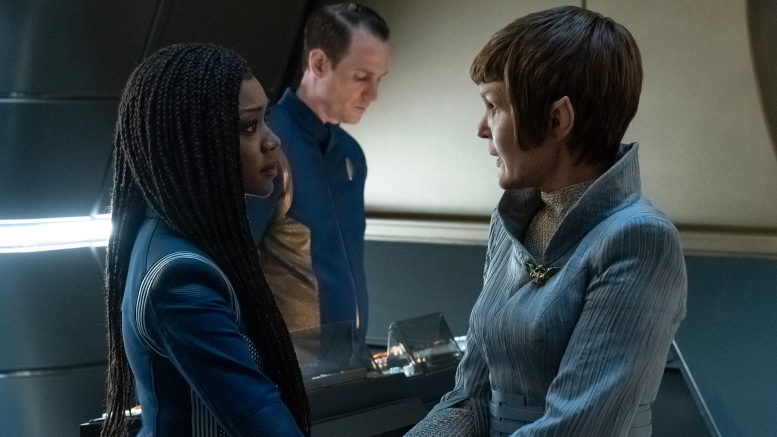
"That Hope is You" orientates Michael to the new status quo of the galaxy. She learns from rogue-with-a-heart-of-gold Cleveland Book a potted version of galaxy-changing events that have effectively disintegrated the Federation. Most notable is the Burn, where inexplicable dilithium instability crippled space travel across the galaxy. Michael's reaction to her new circumstances runs a bit of a gamut. As seen in the image above, Michael strikes a pose reminiscent of Furiosa in Mad Max: Fury Road, when the wayward Imperator learns that the idyllic Green Place is no more. Michael processes her situation partially with the help of a truth serum drug trip. This feels like a clear example of the writers' room hitting on the idea of adding the counterpoint of humor to undercut Michael's potential despair or solemnity.

The viewer is wrestled into submission by beautiful location filming, helping make the episode's strange new world tangible. The episode trades in a melange of tones and phases. It goes from a pitched space battle, to a fraught adventure where Michael shows up and comes into conflict with Book, to a crime saga where our heroes are chased by Andorian and Orion heavies, to a nature documentary where Book reveals himself to be a futuristic Newt Scamander, and finally to the best stop of all. This variety is an asset, showing the different moves in the show's new toolkit.

That final sequence is the soul of the episode. Michael's poignant interaction with Aditya Sahil, a lonely sentinel keeping Starfleet alive at least on a notional level, will put a lump in the throat of any Trek fan. This is why you tear down the Federation, to build it up again. This romantic idea of after the apocalypse, a candle of hope surviving through belief and good work, goes back to great pieces of genre literature like A Canticle for Leibowitz. As a show, Voyager would always say that if the crew didn't hang onto Starfleet principles, they'd become as lost metaphorically as they were physically in the remote Delta Quadrant. The writers of Discovery have a chance to make that The Whole Point. 7/10.

Stray observations:

- Book tells Michael of the devastating Temporal Wars, the fallout of which includes the destruction of time travel technology. Firstly, Time War from Doctor Who, anybody? Secondly, that element of future backstory acknowledges the near-nonsensical Temporal Cold War arc from Enterprise.

- One of the Requiem guards is a Lurian, the same species as Quark's infamously chatty and omnipresent barfly Morn on Deep Space Nine!

Monday, October 12, 2020

Star Trek Randomized Rewatch: Demons


ENT "Demons"

(Not to be confused with the Voyager episode "Demon".)

"Demons" comes as Enterprise wraps up its metastory of the origin of the Federation, casting as its villains an organized Terran supremacist Make Earth Great Again asshole group. These Terra Prime domestic terrorists have in their charge a baby of pioneering significance, a half-human, half-Vulcan child.  Terra Prime's leader, John Frederick Paxton (Peter Weller), considers the child an abomination and rejects what it represents. As an audience, we know what it represents: the future of Star Trek. *Cough* Spock *cough*. The episode clearly has the advantage of depressingly timely villains, but significant storytelling blunders sabotage it.

Weller in some ways is playing a similar character to his villain Admiral Marcus from Star Trek Into Darkness. Both, totally convinced of their ironclad ideology, turn their xenophobia into terrible action. But while Marcus wants to reclaim a level of militarism that Starfleet lost, Paxton is a hardcore isolationist. Paxton's right-hand man literally says of their bigotry, "We're right", to which Paxton responds, "You're a wise man" - which doesn't speak much to nuance. (This right-hand man happens to be Black, which of course is an intentional touch, similar to Brock Peters as Admiral Cartwright expressing blunt racism against Klingons in Star Trek 6: The Undiscovered Country.)

The theme of the episode is legacy, with attention to who writes history, who will be remembered, and how. Paxton muses how history will remember him, which is appropriate since Weller has a PhD in Art History.

But the aforementioned baby (which is often referred to as simply "the Child" - Baby Yoda, much?) is the center of a major revelation: it is the child of T'Pol and Trip Tucker. Everyone in the episode proves to be incredibly dense in the face of this DNA evidence. There's all this hemming and hawing about whether T'Pol was ever secretly pregnant, which she denies, and who takes her at her word with that, and if so, how could this possibly be? This is science fiction! If these people can't figure out how this seemingly impossible child could exist in the 22nd Century, I don't know what to say. And the episode plays as if it's ahead of the audience on this too. It's not.

Worst of all is the disastrous romantic subplot for Travis Mayweather and a reporter named Gannet Brooks. "Demons" is the episode that finally confirms that Anthony Montgomery is a bad actor. The characters, who are supposed to be old flames who eventually rekindle their passion, have awful chemistry, all down to Montgomery, who gives his scene partner nothing in their scenes together. His answer for how to attempt familiar banter is not to attempt at all.

The editing is also off. As the episode has it, Travis' sex scene is interrupted by him putting Enterprise in touch with a contact who can smuggle Trip and T'Pol onto Terra Prime's mining colony. Travis, who already has an old friend character in the episode, is given another one off-screen. Why couldn't it be Hoshi's contact at the mining colony?

Stray observations:

- That's the Mayor from Buffy (Harry Groener) giving the fancy speeches.

- The Coridan ambassador looks like he has a face-hugger from Alien permanently affixed on him.

"Demons" has the right themes in place, and its villains are unfortunately timely, but the twin sins of not respecting the audience's intelligence with the baby twist, and Anthony Montgomery's terrible performance, take the wind out of its solar sails. 4/10.

Sunday, October 11, 2020

Star Trek Randomized Rewatch: A Simple Investigation

DS9 "A Simple Investigation"

 "Somebody stop me!" - Jadzia Dax, maybe referencing The Mask?

Of all the Deep Space Nine characters to get a romance of the week episode, Odo is one of the least likely, and "A Simple Investigation' uses that to drive the story, particularly how the rest of the cast minus Worf bemusedly encourage his romance along for his sake. As a setup I guess it's supposed to be vaguely noir - one issue with the episode may be a slightly unmoored tone. Is it space noir? Is it more of an espionage plot? Are the thugs supposed to be comic relief or not?

A woman named Arissa (Dey Young) sparks with Odo in Quark's against the backdrop of trying to get out from under a notorious Orion Syndicate gangster called Draim, who she's been working for as a hacker. Eventually, after Arissa and Odo develop an intense bond, the rug is pulled from under them as it's revealed that the version of Arissa we've been following is a sleeper agent whose memories were voluntarily patched and rewritten for a sting operation on the Orion crime boss.

"A Simple Investigation" is a sexually frank episode, especially for Star Trek. In Arissa's implanted backstory, she was a "net-girl", or remote sex worker. Odo loses his virginity to Arissa (not counting an experience on the Founders' homeworld he describes as ambiguously sexual - that changeling bit of turning to goo with each other that seemingly goes a little beyond the standard "joining"). And in the "morning after" scene, the episode gives us the extraordinary sight of... lovey-dovey flirty Odo?

Part of what contributes to the undercurrent of confusion are the plot revelations. Arissa turns out to be a surgically-altered member of a race we've never heard of called the Idanians, who used her to infiltrate the Draim's organization. Her handler shows up and brags about how he's going to indict Draim. But this is space. Who has jurisdiction? Is the Idanian homeworld part of the Orion Syndicate? Maybe these Idanians are sort of like the Fenris Rangers from Picard.

The b-plot of the episode is a brief, low-budget return to Doctor Bashir's James Bond-esque holosuite program from "Our Man Bashir", which provides a couple laughs. "A Simple Investigation" is a decent if not hugely engaging episode, though the central romance between Arissa and Odo (and the chemistry between Young and Rene Auberjonois) works well enough. 6/10.

Thursday, July 2, 2020

Star Trek Randomized Rewatch: We'll Always Have Paris

TNG "We'll Always Have Paris"
"We'll Always Have Paris" blazes a trail for The Next Generation in a couple ways. It's the first "timey-wimey" episode, featuring time distortions (later examples: "Time Squared", "Cause and Effect", etc.). And not counting Beverly Crusher, it's the first Picard's old flame/Picard love interest episode (later examples: "The Measure of a Man", "Lessons", etc.). So cue rote time trickery and Picard wistfully recreating a Paris cafe on the holodeck.

Jenice Manheim, Picard's former lover of 22 years ago, is played by Michelle Phillips, best known from the 1960s rock group The Mamas and the Papas. With all these time distortions, it's a real "Monday Monday" situation, huh? "California Dreamin'"? More like Paris Dreamin'.

... Maybe that doesn't work too well.

The episode runs those two strands in parallel, pioneering their use in the show but in a decidedly workmanlike fashion. One fun aspect of the holodeck program is seeing future production design in the 24th Century French cafe. The Space Fashion Choices for those women scream out the trademark of costume designer William Ware Theiss, lending his talents familiar from the original series to the first season of TNG. It is details like this that make TNG Season 1 an aesthetically liminal transition point between the gaudy TOS and the more austere TNG.

Being a showcase for Picard, he is also seen fencing with an anonymous crew member. Seeing Picard in "dab hand with a cutlass" mode recalls his time as swordmaster Gurney Halleck in David Lynch's Dune - or for that matter, Lord Leondegrance in John Boorman's Excalibur.

Details like that liven up a somewhat routine episode. There is one moment at the episode's close I want to pick out, before a painfully awkward comedy ending. Picard says the Enterprise is due for "much needed" shore leave. Could it be a subtle reference to the loss of Tasha Yar, killed in action in the episode directly prior...?

A decent but unremarkable romance/science puzzle. 5/10.

P.S.: As a Star Wars fan, the Enterprise's trip to Vandor 4 recalls Han Solo and crew's Conveyex heist on Vandor 1 in Solo: A Star Wars Story.

Saturday, June 6, 2020

Star Trek Randomized Rewatch: The Perfect Mate

TNG "The Perfect Mate"
A centuries-long war between two planets, coming to an end through an alliance sealed by marriage. An ambassador ferrying the bride on the Enterprise, and said ambassador falls victim to a violent mishap and ends up in sickbay. A romantic connection between the bride and the captain of the Enterprise. If this all sounds familiar, it's because "The Perfect Mate" shares many basic similarities with another episode we've recently covered in this random rewatch: the original series' "Elaan of Troyius"!

The skeleton of each episode is similar, but thankfully that's where they end. In terms of subtlety, and quality of character work and writing, "The Perfect Mate" is a drastic improvement. Famke Janssen guest stars as Kamala, a "metamorph" whose sole purpose is to tailer herself to the pleasure of their future betrothed. (In a subversive detail, it's mentioned that most metamorphs are male.) Naturally this doesn't sit terribly well with the Enterprise crew (particularly Beverly Crusher), but if Kamala truly derives pleasure from subsuming herself to someone else, the issue isn't as clear cut as one might think.

The episode teases out this dynamic well, articulating multiple sides, and taking unexpected turns in the plot. Alrik, the man Kamala will marry, is established to be rather dismissive of Kamala. In a haunting moment, Picard wonders to Beverly how Kamala will change to accommodate Alrik. The implication is clear: there's a danger that to please a man who doesn't respect her, she will void herself of the sharp intelligence that defines her now, and hollow herself out. There's a small victory in that Kamala makes clear that she will accommodate Alrik, but she won't change for him.

Kamala finds herself imprinting romantically on Patrick Stewart's Picard. This is quite something when you consider that in the X-Men movies, Janssen's Jean Grey is a professor who works for Stewart, who was recruited by Stewart when she was a little girl. Remarkably, Kamala even refers to herself as a mutant, just as Jean Grey and her fellow X-Men are mutants.

There's a notably dirty joke in the episode. After Kamala comes on to a flustered Riker, he calls in and says, "I'll be in Holodeck 4." What he'll be doing in Holodeck 4 is left to the imagination, but this is a true Jayne from Firefly, "I'll be in my bunk" moment.

"The Perfect Mate" is a tender and well-told tale of space romance, and one-ups "Elaan of Troyius" in every way except camp value. 7/10.

Canon connections:
- One of the Ferengi is played by Max Grodenchik, who will in future play the Ferengi Rom in Deep Space Nine.
- Geordi asks the Ferengi if they want to see the dolphins on board. I believe this was a cute detail in the Next Generation Technical Manual, which identified an area for dolphins on the Enterprise-D.
- Kamala's ceremonial line, "I am for you, Alrik of Valt", calls back to Losira's siren words in the original series episode "That Which Survives". She too said ostentatiously "I am for you".

Saturday, May 30, 2020

Star Trek Randomized Rewatch: Repression

VOY "Repression"
The raison d'être of the unusual psychological thriller episode "Repression" is to exploit the Starfleet/Maquis conflict at the heart of Voyager's premise. The catch is that this is done the only way the show can: when that conflict is totally due to an outside influence.

In this case, mind control, courtesy of a deranged Bajoran vedek named Teero Anaydis (Keith Szarabajka). In a very brief and disorienting teaser, Teero is introduced, flanked by what looks like Star Trek concept art, chanting in Bajoran, and hatching a plan to brainwash Chakotay's former Maquis crew, including Tuvok (undercover at the time) and B'Elanna.

The whole issue of the collegiate partnership between Starfleet and Maquis crews on Voyager speaks to the writerly problem of Star Trek. The crews must be in harmonious lockstep because of Trekkian idealism, so the only time their tribalism can be a factor is in an extraordinary circumstance like this mind control. Star Trek is being circumvented to take advantage of a major aspect of the show's basic premise. It's a fascinating and convoluted dynamic.

The episode finds levity in a holodeck replica of a Chicago movie theater. At first hosting a relatively small audience, there's a spectacular amount of leg room, but for a packed house, the seating arrangement becomes more packed. In a nice touch, the carpets suggest the basic yellow and black holodeck grid.

The mind control plot is resolved extremely quickly at the end, Tuvok's psychological unrest overcome. "Repression" has issues as a piece of drama, but stands out for its attempt at askew psychodrama. 6/10.

Tuesday, May 26, 2020

Star Trek Randomized Rewatch: Wolf in the Fold

ST "Wolf in the Fold"
"Wolf in the Fold" doesn't do much by halves. It's an insane episode, and with every passing improbable turn of the plot (like the twist of a stage knife), it becomes even more of a helium-laugh fest.

On the face of it, the premise would be anything but amusing; Scotty is accused of murder, his bloody hands on the murder weapon. There is a thread throughout the episode of, shall we say... exaggeration. Kirk, McCoy, and Scotty are taking their shore leave on a planet home to a "completely hedonistic society", to allow Scotty to get over a recent development in his psychological makeup: a "total resentment of women", because a female engineer was involved in an accident that gave Scotty a head wound.

So from the start, two things are clear. We are in the realm of cartoon psychodrama. And the original Star Trek finds itself once again on shaky misogynistic grounds. Writer Robert Bloch (of the novel Psycho) deploys his big twist late in the game: the murders were in fact carried out by Jack the Ripper, who all these centuries has lived on as a non-corporeal entity! And if that's not enough of a WTF'er, the crew foils Jack's plot while extremely high!

That's right, McCoy injects the crew with a tranquilizer that has a blissing out effect. Add to all this that the primary human antagonist of the episode and vessel of Jack the Ripper, Hengist, is played by John Fiedler, also known as the voice of Piglet.

"Wolf in the Fold"'s gender dynamics haven't aged well, but the episode is a bonkers laugh riot. I don't know how to rate something like this but on balance we'll go with 6/10.

For a less campy take on Jack the Ripper in the 23rd Century, check out the Babylon 5 episode "Comes the Inquisitor".