Showing posts with label Star Wars: The Mandalorian. Show all posts

Wednesday, December 30, 2020

Star Wars: The Mandalorian Season 2 Overview

Star Wars: The Mandalorian Season 2

Average episode rating: 7.4/10

No one expected Baby Yoda. The reveal at the end of The Mandalorian's first episode, utilizing the same silhouetted-ears-from-behind shot that heralded Force ghost Yoda's appearance in The Last Jedi, was blindsiding. While hints were in the air that the titular character would come to protect a young charge (the Lone Wolf and Cub setup), the reveal redefined the conception of the show from a notional bounty of the week structure to odd couple domestic adventure.

By making the Child Yoda's species, the reveal also tied into the larger Star Wars mythology, a project that the second season expanded with many tendrils. With an ear to the ground, appearances from Boba Fett, Bo-Katan Kryze, and Ahsoka Tano came as welcome developments but not surprises. But Luke Skywalker and R2-D2 were shocking cameos, at least to me.

Spinning out of the first season, a quest to find the Child's (now Grogu's) kind was interpreted by most to be a search for other members of Yoda and Yaddle's species. But Season 2 reoriented that, avoiding demystification via a planet of the Kermits by defining Grogu's "kind" as another Jedi. And in a painful, poignant scene, Din said goodbye to Grogu, leaving him in the charge of Luke. For my part, I am prepared for and content with Grogu never appearing on the show again, but it also seems unthinkable that part of what defines the show as a piece of drama and a cultural phenomenon will never return. But I remain open to either cold turkey removal of Grogu for good, or an eventual reunion.

The show's portrayals of both its Jedi characters, Ahsoka and Luke, skewed toward the reverent, like these were mythological figures and not flesh and blood people. Not that there weren't precious dewdrops of characterization from both, but the show itself reacted to them, especially Luke, with a certain depersonalizing awe. Luke never names himself; he represents the legend of the Jedi. The episode in which he appears is called "The Rescue", and Luke's rescue here is quite a contrast from A New Hope's "I'm Luke Skywalker, I'm here to rescue you!"

The build-up to his appearance is kicked off by the arrival of his iconic X-Wing. This continues the mythologizing of that craft, particularly in The Rise of Skywalker. Rey leads the Resistance to Exegol in that fighter and is recognized over sensors with, "That's Luke Skywalker's X-Wing." In a moment of jubilation, Finn exclaims, "Red Five is in the air!" In that same movie, we see a de-aged Return of the Jedi-era Mark Hamill face on a body double, showing that The Mandalorian is not the first Star Wars project to make that move.

These big character reveals may dominate the headlines, but to the show's credit it also brought back guest stars from Season 1 for further development. While Greef Karga only featured in one episode, Cara Dune and Fennec Shand's roles expanded, and minor characters like the Mythrol and Q9-0 came back with a new spin on their characterization. (Peli Motto came back much the same!) The poster child of this character rehabilitation was certainly Migs Mayfeld, a fairly generic rogue in Season 1, a likable, almost wise antihero in Season 2.

Season 2 saw composer Ludwig Göransson incorporate past Star Wars music into the show for the first time: From Kevin Kiner, Ahsoka's theme. From John Williams, Yoda's theme, the Star Wars theme, and the Force theme.

There was also acknowledgement of some of George Lucas' foundational influences when creating Star Wars, namely Akira Kurosawa movies and Frank Herbert's Dune. Lucas mentee Dave Filoni framed Ahsoka as a ronin samurai Jedi, using shots taken from Yojimbo and Seven Samurai. The town in that episode was called Caladan, a name from Dune, and the spectacle of a krayt dragon was extremely reminiscent of a sandworm.

Season 2 followed the "bigger and better" paradigm, making for a fine companion piece with Season 1. As the show goes on, it must redefine what the show is yet again. All the Mandalorian lore was a sideshow in the end to the bond between surrogate father and son. What is the show now? I'm fascinated to find out.

Elements from Star Wars canon depicted in live-action for the first time in The Mandalorian Season 2:

- Cobb Vanth, from the Aftermath novels

- A live krayt dragon

- Temuera Morrison lending more than his voice to Boba Fett

- Bo-Katan Kryze

- Dark troopers

- Ahsoka Tano

- A convor (space owl)

- Mandalorian dagger ship

Top 5 moments:

5) Jon Favreau restages Cowboys & Aliens vs. a krayt dragon, "The Marshal"

4) Mayfeld shoots first, "The Believer"

3) Ahsoka Tano vs. Morgan Elsbeth, "The Jedi"

2) Luke's arrival/goodbye to Grogu, "The Rescue"

1) Armored Boba Fett jets down into the fray, "The Tragedy"

Sunday, December 20, 2020

Star Wars: The Mandalorian - The Rescue Review

MND "The Rescue"
The season 2 finale of The Mandalorian has an outsize connection to the larger Star Wars canon, to an awe-inspiring extent, in fact. Crucial developments shed light on the rightful rule of Mandalore (Bo-Katan is back, gunning for the darksaber that Gideon took as a spoil of genocide), the state of a new Luke Skywalker-shaped (!) Jedi order, and even the power vacuum left by Jabba the Hutt's death (Boba Fett and Fennec Shand move right in with an efficient power play).

None of that matters to Din Djarin.

That's how all these planet-shaking story points are held back from overshadowing the heart of this show. Din is here not as a Mandalorian, not as a child of Death Watch, not as a bounty hunter, not as a "Ranger of the New Republic" come to arrest remnant Imperials, but only as a father.

Even his precious Creed matters not, if it keeps him from showing his face to his son, and making that last humanoid connection, before sending Grogu with Luke. There stands Luke: the man who destroyed the first Death Star, founded Rogue Squadron in honor of Jyn Erso and company's sacrifice, and turned the monolithically evil Darth Vader back to the light side of the Force. But all Din needs to know is that Luke can help his son. And so, like Leia later will with her son Ben, Din places Grogu in Luke's care, to train as a Jedi padawan.

From a filmmaking perspective, the Luke reveal is firmly in "the Legend of Luke" territory. Almost angelic in his implacable power and serene facade, there's no interest in humanizing details. Appropriate for the context of this episode, his status as Jedi is almost unknowable.

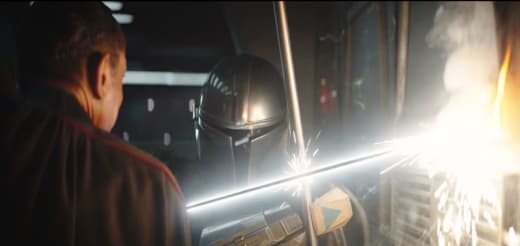
Taking a step back from the luminous beings stuff, Din attacks Gideon's cruiser with an all-female strike team, including the returning Bo-Katan and Koska Reeves. (Amusingly, Bo-Katan taunts Boba Fett for being a clone, like the Republic clones she once fought alongside.) While Boba Fett creates a plausible cover story for boarding, the three Mandalorians plus Fennec and Cara Dune run up against Gideon's elite Dark Trooper droids. Like something out of The Black Hole, or akin to original Battlestar Galactica Cylons (fitting given Katee Sackhoff's presence), the Dark Troopers are a potentially overwhelming threat that Luke eventually extinguishes.

Throughout the episode, composer Ludwig Göransson simply goes for broke. When the title of the show is thrown up, a pumped-up version of the main theme plays. The Dark Troopers are given an ostentatious metallic techno riff. And even the reveal of a TIE Fighter makes the little unshielded fighter seem like the stuff of nightmares. During Luke's scenes, a redressed version of the main Star Wars theme airs, plus a fairly straight quotation of the Force theme.

Din finds Gideon guarding Grogu, and the two duel, beskar spear against darksaber, until Din is victorious. But like the Elder Wand in Harry Potter, the darksaber can only be claimed by besting the owner in combat, foreshadowing a future conflict between Bo-Katan and a disinterested Din.

There are a lot of elements to this episode that after all is predominantly a propulsive piece of action. And while darksaber lore and especially a visit from Luke and R2-D2 are huge deals to fans, the episode's trick is that in Din's headspace, he has a singular parental goal. He has made safe Grogu and delivered him to a willing Jedi. Doesn't make Din's tears sting less. 8/10.

Stray observations:

- Boba Fett doesn't strike me as the type to sit on a throne, but there he and Fennec are, fresh from a spot of Bib Fortuna-murdering, taking up residence at Jabba's Palace.

- One of the Imperial shuttle pilots canonizes the old Clerks joke about "the contractors on the Death Star". He's played by Thomas E. Sullivan, who also played the villainous Nathaniel Malick in Agents of S.H.I.E.L.D., featuring Fennec Shand actor Ming-Na Wen.

Friday, December 11, 2020

Star Wars: The Mandalorian - The Believer Review

MND "The Believer"
And so it came to pass, that "The Believer" would be the first Mandalorian episode not to feature Grogu, and there were riots in the streets... Just kidding. In Grogu's absence, Din assembles his version of the Avengers (Cara Dune, Boba Fett, Fennec Shand, newly-sprung prisoner Migs Mayfeld from last season's "The Prisoner") for an arcane mission to triangulate the location of Moff Gideon's ship - in a dynamic episode alive to the political context of the galaxy at this time, through the personal lens of Mayfeld of all people.

I wasn't a big fan of Mayfeld from last season. He, like the other guest characters in "The Prisoner", had a performative toughness to them. But the characterization here is downright sympathetic. His days as a stormtrooper have haunted him, particularly as he personalizes Operation Cinder, the defeated Palpatine's devastating scorched earth campaign. He encounters an old superior officer named Valin Hess (played by Richard Brake with a real "evil Dennis Quaid" energy), and when Mayfeld can't take Hess' neofascist drivel a second longer, Mayfeld shoots first.

To hear Hess tell it, the people of the galaxy, like the exploited natives of Morak near this Imperial mining facility, will eventually welcome order with open arms. While he overestimates the citizenry's future receptiveness to the First Order, he speaks what he feels is truth from his point of view. The theme of shifting political reality in the episode is captured in its centerpiece moment, the subversive reversal where Din and Mayfeld are saved from pirates by TIE Fighter pilots swooping in like they're Han Solo. Din and Mayfeld, disguised as Imperial transport drivers, are given an excessively happy heroes' welcome at the facility, the troopers probably unused to seeing main character-worthy heroics from Imperial rank and file.

Mayfeld questions foundational aspects of Din's creed, and as events unfold, Din must remove his helmet to complete his mission. Technically he has betrayed his Creed, but that is a rigid point of view. He certainly looks uncomfortable with it, though. The man introduced with "I can bring you in warm or I can bring you in cold", rendered vulnerable. The episode's adherence to that classic Star Wars theme of "from a certain point of view" finds its climax at the end, when Din parrots Gideon's monologue about Grogu from Season 1 right back at him, in a righteous new context.

The action of the episode works like muscular punctuation. Things take a Mad Max-shaped turn when pirates in skiffs beset the transport. And Boba Fett gets another punch-the-air moment when he uses the sound-warping seismic charges from Attack of the Clones to take out a couple TIEs (more on this in Stray Observations).

"The Believer" is an episode of unexpected quality, or to be more specific, unexpected depth. Especially given the surprise mileage from bringing the loudmouth Mayfeld back to the show. Roll on the finale next week. 7/10.

Stray observations:

- This episode has an Office Space reference?! Mayfeld says he and Din have to fill out those TPS reports.

- We finally get to see more of the interior of Slave 1 beyond the cockpit, including the weird rotation of the body.

- Nice to see the Scarif shoretrooper design from Rogue One return on this vaguely tropical planet. The transport driver costume is a hybrid of a redesigned Jedha assault tank driver helmet from Rogue One and the Mimban mudtrooper armor from Solo.

- As aforementioned, we last saw Jango Fett deploy seismic charges against Obi-Wan in Attack of the Clones. And the boy who said "Get 'im, Dad, get 'im! Fi-yah!" has now grown into a man. This is the first time we've seen Boba's Slave 1 use the charges... except for the Geonosis scenario in Disneyland's Star Tours ride!

Saturday, December 5, 2020

Star Wars: The Mandalorian - The Tragedy Review

MND "The Tragedy"

In "The Jedi", Ahsoka was revealed in all her glory in the very first scene, which was wonderful in its own way. In "The Tragedy", Boba Fett, having surreptitiously retrieved his armor from the Razor Crest, jetpacks into a fight after a runway of build-up, making for a truly fan-pleasing moment. I'm not a "Boba Fett bro", but that was something special, a highlight of a fantastic slice of Star Wars.

On the planet Tython, Din takes Grogu to the seeing stone of a Stonehenge-like Jedi Temple, only to encounter Boba Fett (arriving in Slave I!) and a not-dead cyborg-ized Fennec Shand looking to make a deal for the armor Din got from Cobb Vanth in "The Marshal". But Gideon's Imperial forces follow them and a pitched battle ensues.

The episode gets the show off the Volume studio stage into glorious sun-kissed location filming, setting a bright stage for a glorious extended action sequence marshaled by Robert Rodriguez (Desperado, From Dusk till Dawn). Boba, Fennec, and Din cut swathes through waves of stormtroopers, until rocket-booted Dark Troopers (updated from Legends continuity) kidnap Grogu.

The centerpiece of the episode is Temuera Morrison's expanded role as Boba Fett, having way more to say in this episode than in, say, The Empire Strikes Back. After years of back and forth, we learn that Boba's father Jango Fett was indeed a Mandalorian foundling. And Boba, being a clone, actually goes there and quotes his father by calling himself "a simple man trying to make his way in the universe". It should be noted that in early concept art for The Mandalorian, Boba Fett was used as an illustrative placeholder cradling Grogu before Din's distinct design was in place. And now things have come full circle, and Boba is a major part of the show.

Going into the episode, a focus on "that Jedi stuff", as Din calls it, seemed top of mind given the Temple setting. Indeed, Grogu's experience on the stone seems to amplify his power, as two stormtroopers find to their cost. But where last episode tapped into the samurai genre foundation of Star Wars, this one stages a space Western skirmish. The show again brings out the E-Web blaster cannon, extrapolating the old Western trope of the gatling gun. It's pew-pew action at its finest, thrilling every step of the way. 9/10.

Stray observations:

- What is it with Nevarro's new administration and putting your feet on your desk? First Greef in "The Siege", and now Cara in this episode.

- The Imperial troop transports are clear design precursors to First Order troop transports. Boba Fett rockets the escaping transports, vaguely reminiscent of Rey destroying another escaping transport with Force lightning on Pasaana in The Rise of Skywalker.

Saturday, November 28, 2020

Star Wars: The Mandalorian - The Jedi Review

MND "The Jedi"
"The Jedi" wastes no time building up to its namesake. There is beloved Clone Wars and Rebels hero Ahsoka Tano, in live-action for the first time, playing the part of an unknowable ronin, thorn in the side of industrial-level exploiter Morgan Elsbeth. That villain's name is like a witch straight out of a fairy tale, and so is the setting. Elsbeth has despoiled the planet Corvus, rendering the outskirts of the town of Calodan a dark, twisted Tim Burton forest. The bursts of action the episode unleashes are made all the more dreamlike because they might as well take place in Sleepy Hollow.

Elsbeth's agenda feels more corporate than militaristic, making her an appropriate foil for Ahsoka, who fought the corrupt conglomerates of the Separatists during the Clone Wars. Even so, the samurai movie meets Brothers Grimm aesthetic recalls something more elemental. When Ahsoka and Elsbeth slowly take each other's measure and face off in a vaguely Japanese garden, it's so Kurosawa it hurts.

It's a dynamic that Din walks into as an outsider. After the episode gives us a brief taste of explosive Jedi vs. Mandalorian action when Ahsoka and Din clash, Din quickly gets to his true purpose in seeking her out. Reaching out with her mind, Ahsoka senses that the Child's true name is Grogu. It's humorous seeing the little one snap to attention every time someone says the name. Grogu was trained in the Jedi Temple but has a decades-long gap in its memory.

When Ahsoka mentions Yoda as another member of Grogu's species, composer Ludwig Göransson deploys Yoda's theme. And when Ahsoka shows herself at Calodan's gate, I detect a flourish of Kevin Kiner's Ahsoka theme. This is the first time The Mandalorian has quoted other Star Wars music. When Grogu used the Force to lift the Mudhorn, the Force theme didn't play. When Moff Gideon landed his TIE Fighter, the Imperial March wasn't trotted out.

Din agrees to help Ahsoka deal with the Elsbeth situation. Ahsoka and Elsbeth's fight is a highlight, with the latter using a beskar spear reminiscent of the quicksilver baton Captain Phasma dueled Finn with in The Last Jedi. Victorious, Ahsoka demands Elsbeth reveal the location of her boss, Grand Admiral Thrawn (?!) - more on that in Stray Observations. 

Ultimately, Ahsoka sees Grogu's attachment to Din as a father figure, and declines to train the child. Her experience with Anakin has only reinforced her adherence to the Jedi Order's old tenets. She does point the way to a Jedi temple, meaning that more Force mysticism is on the cards for this show.

Rosario Dawson's portrayal of Ahsoka is effective (even if her voice isn't much of a match for Ashley Eckstein's), and director Dave Filoni's use of Ahsoka action in quick bursts works excellently well. "The Jedi" is another workout for a dark color palette on this show, but the atmosphere is thick. Filoni's invocation of samurai movie tropes, just putting Ahsoka and Elsbeth opposite each other in a widescreen frame, is just as magnetic on screen as Force Projection Luke squaring off with Kylo Ren on Crait. Might as well call the episode "The Samurai". 8/10.

Stray observations:

- While appearances in some fashion by Boba Fett, Bo-Katan Kryze, and Ahsoka Tano could be foreseen, the Thrawn namedrop was a surprise. This raises a big timeline question. In a coda at the end of Rebels (taking place at an unspecified point after the Battle of Endor), Ahsoka and Sabine Wren went on a quest to find Ezra Bridger, who was spirited away across the galaxy along with Thrawn. So is "The Jedi" before or after that quest? Seems to me it would likely be after, meaning that Thrawn's story is far from over.

- Ahsoka says she's only known one other of Grogu's species, Yoda. I guess Jedi Council member Yaddle was before Ahsoka's time?

Friday, November 20, 2020

Star Wars: The Mandalorian - The Siege Review

MND "The Siege"
This week's chapter returns to Nevarro for dynamic action on a bigger scale than the first season, while veritably littering the episode with easter eggs and self-reflexive jokes. Reconnecting with Greef Karga, Cara Dune, and former quarry Mythrol, Din is enlisted to take out an Imperial Remnant facility. It all adds up to the most purely adrenalized action episode the show has featured so far.

The episode begins with a comedy bit of Din exasperatedly trying to get the Child to follow technical instructions. Comparisons with Rocket desperately trying to get Baby Groot to press the correct button in Guardians of the Galaxy Vol. 2 are unavoidable. Afterward, the show features its most 2020 moment yet: Din lifting his helmet slightly to drink something.

On Nevarro, Cara is a Marshal in her own right (after this season's titular "Marshal", Cobb Vanth) and Greef is a Magistrate. The former hive of scum and villainy now hosts a school, with a protocol droid giving out the kind of geographical exposition you usually only find in tie-in reference books. And from the very first episode, Mythrol is back, admittedly a character I struggled with back then. His contemporary quality was something I had to get over when acclimating to the show.

Once our heroes have infiltrated the Imperial base, things take a turn for the stranger. This is Dr. Pershing's lab, home to misshapen genetically engineered bodies not unlike the infamous vat of Snokes on Exegol in The Rise of Skywalker. A recording of Pershing makes clear that he was trying to inject blood into these vessels with a high "M count", namely the Child's blood. Almost certainly, that M stands for midi-chlorians.

A comforting and exciting array of classic Star Wars action ensues. The stormtroopers even say, "Blast 'em", like they're in Mos Eisley's Docking Bay 94. There's the corridor blasting like we got last week, but also a chase through a canyon featuring speeder bikes and TIE Fighters. This type of action, filled with derring-do followed by whoops and cheers, feels different for this show, more in line with the saga films. There are multiple "theme park ride" moments - even the Child raises its hands during a roller coaster-like dogfight.

Actors have done good work directing this show, notably Bryce Dallas Howard. With "The Siege", Carl Weathers gets in on the act, and interestingly, in directing himself he seems to have tamped down his own grandly theatrical impulses that made Greef such a huge personality in Season 1. This is a Greef of more authority and less showmanship. But as an episode, "The Siege" isn't lacking in showmanship: a solid action chapter with weirder touches on the fringes. 7/10.

Stray observations:

- Last week, the show once again joked about stormtroopers being lousy shots. This week, it's the lack of guard rails in Imperial architecture. 

- The protocol droid teacher mentions the Akkadese Maelstrom outside Kessel, where Han made the Kessel Run in Solo. Also the current New Republic capitol on Mon Mothma's home planet Chandrila - but since the capitol is designed to periodically cycle through different homes, it's on Hosnian Prime when the First Order's Starkiller Base destroys the seat of government in The Force Awakens.

- The untrustworthy engineer employed by Greef is Mimbanese. This species was introduced in Solo on the planet Mimban; recall Han's sergeant calling them "the hostiles" and Han retorting, "it's their planet, we're the hostiles". Recently one of the New Republic pilots in the Squadrons video game was Mimbanese.

- The reveal of Moff Gideon's mid-size cruiser is, of course, reminiscent of the Star Destroyer in the first shot of A New Hope. In that cruiser, he's got rows and rows of... they don't seem to be Death Troopers, they're not TIE pilots, it's not Vader armor. They look like something new.

- In last week's review, I perversely did not bring up the fan-galvanizing mention of Ahsoka Tano, who will likely appear later this season (!); if the structure of Season 1 is any guide, three closely connected episodes are followed by three that relatively stand alone, leading into a big two-part finale. Perhaps Ahsoka will appear in the final two episodes of this season.

Saturday, November 14, 2020

Star Wars: The Mandalorian - The Heiress Review

MND "The Heiress"
The third episode of The Mandalorian Season 1 got a lot of mileage by featuring a cadre of Mandalorians jet-packing in to save the day. Now, the third episode of Season 2 does the same. Leaving a trail of righteous fanservice in the sky, "The Heiress" features high adventure, guest starring a beloved Clone Wars and Rebels character making her live-action debut, and provides meat and potatoes thrills all the way through.

Din successfully delivers Frog Lady to her companion and makes a deal with a Quarren crew to find other Mandalorians. It's a trap, but those very Mandalorians rescue Din and the Child from a death on the high seas. And Katee Sackhoff, who voiced this role on the aforementioned animated shows, appears as Bo-Katan Kryze, a punch-the-air moment for Star Wars fans. In animation, Bo-Katan is an intense, bitter character. Sackhoff brings a lighter charisma to her in live-action, that being part of her default screen presence.

When Bo-Katan and her companions casually take off their helmets, Din freaks out and smugly looks down on their disregard for the Creed. It becomes clear that Din and the Mandalorian covert from Season 1 are a fringe orthodox cult with their own stringent code on never removing their helmets in the presence of another living being. A few things are going on here. On one hand it's writer Jon Favreau's idea of Mandalorian mystery coming into conflict with new canon's (read: Dave Filoni's) face-front Mandos, and finally reconciling the two.

It's also a slick move on the show's part to cast the Mandalorians the show's been following in a different light. Their certainty of purpose can look like reverent conviction or fanaticism. And in a way I'm put in the interesting position of not being on Din's side here. Here's Bo-Katan, the rightful ruler of Mandalore the Great, and Din is acting like an asshole.

Star Trek's Worf, a Klingon orphaned and taken in by human parents on Earth, overcompensates for this by acting "more Klingon than Klingon". He insists on Klingon tradition all the more rigorously, precisely because he is the product of a human upbringing. A similar thing characterizes Din. A foundling rescued and recruited into a strict Mandalorian Creed, Din holds onto such an ethos to a fault. The Way did save his life, after all.

Bo-Katan's mission is some standard Imperial Remnant sabotage, with the aim of stealing weapons and a cruiser. This is straightforward swashbuckling fare in a cool Star Wars context. But the dynamism of the episode's action is inconsistent. Bo-Katan's rescue scene on the space-boat is a quick, solid setpiece with some variety of technique, but much of the action on the cruiser boils down to her cadre running and gunning in a straight line down an Imperial corridor - or more accurately, walking and gunning. Granted, this is core Star Wars DNA stuff (from the Death Star corridors to Finn, Poe, and Chewbacca blasting away troopers on the Star Destroyer Steadfast in The Rise of Skywalker), but not as dynamic as the earlier boat rescue.

"The Heiress" of the title seems to refer to Bo-Katan Kryze, heiress to the rule of Mandalore. It is her presence that gives the show one of its most fan-pleasing episodes yet. And aside from some reservations on the strength of the climax, this is a fine, down-the-middle action episode that complicates the show's Mandalorian world-building. 7/10.

Stray observations:

- Check out the uncannily Earth-like fisherman sweater that Mon Calimari is rocking in the image above. The bustling port environment he works in is based on early Takodana concept art, at least by eyeballing The Force Awakens art book - before the Takodana market concept (codenamed "Exotic City") became Maz Kanata's castle. 

- "Everyone seated needs to eat", the tavern worker says to Din Djarin. What is this, Oga's Cantina at Galaxy's Edge? The Disneyland establishment requires each guest to order something.

Friday, November 6, 2020

Star Wars: The Mandalorian - The Passenger Review

MND "The Passenger"
"The Passenger" is the most overtly comedic episode of the show so far, which is unsurprising given that Peyton Reed (Bring it on, Ant-Man) is in the director's chair this week. While leavened with horror and adventure elements, the episode also approaches the feel of a hangout episode at times, from Din Djarin's awkward interactions with his passenger (a character the subtitles literally refer to as "Frog Lady") to the Child's insatiable appetite for incubating life-forms. We even get a quiet moment that reveals Din and his Child's nighttime routine and sleeping arrangements on the Razor Crest.

If last week's chapter was a sequel to Season 1's "The Gunslinger", this week's episode is a sequel to "The Prisoner". Din's entanglement with the New Republic prison facility from that episode has consequences. Richard Ayoade briefly returns as the voice of the dismantled droid Q9-0. And most notoriously of all, series co-creator Dave Filoni returns as X-Wing pilot Trapper Wolf - but this time, he leaves most of the talking to his wingman Carson Teva, played by actual actor Paul Sun-Hyung Lee.

In a way, "The Passenger" is like Din's very bad day. He falls into a trap and crashes his speeder bike, which puts the Child in imminent danger. He's a little uncomfortable ferrying Frog Lady, but things take a turn for the worse when he crashes the Razor Crest to avoid New Republic X-Wings... only to find a nest of ice spiders that exist somewhere between George R.R. Martin's wight spiders and Peter Jackson's repulsive worms from King Kong. He's saved by Wolf and Teva, who basically say they watched "The Prisoner" and saw that Din isn't such a bad guy. The episode plays into the subjectivity we're used to from the show; Reed fades to black whenever Din loses consciousness. And in a nice touch, when Din looks to his New Republic saviors, the X-Wings' blinding headlights feel like those of cop cars.

The ice spider portion of the episode is quite well done. The problem is, we're in monster movie territory again, so soon after the krayt dragon last week. While each episode's take on it is effective, it feels slightly redundant to go back to that well so soon.

The last two episodes have been sequels to specific Season 1 installments, and from my perspective, the two weakest episodes of the debut season at that. Connecting back to them gives the series' tapestry a richer sheen. The episode's humorous slant is also good for some amusing moments. But playing the monster card two weeks in a row dilutes the impact a bit. 6/10.

Saturday, October 31, 2020

Star Wars: The Mandalorian - The Marshal Review

MND "The Marshal"

Last season's fifth chapter, "The Gunslinger", gets a veritable sequel in "The Marshal". Amy Sedaris' Peli returns, and the small but impactful scene of Din Djarin communicating with the Tuskens on their terms essentially gets an episode-length expansion. And as a small spot of krayt dragon infestation comes to an explosive head, Jon Favreau (series co-creator directing for the show for the first time) presents a setpiece  without peer even in his garlanded cinematic filmography.

It feels redundant to say it, but "The Marshal" leans hard into tropes of the western genre. A ramshackle town, defended by a lone marshal, must come together with their Tusken Raider territorial rivals to take down a massive krayt dragon that threatens both camps. Indeed, Favreau himself has been here before - see Cowboys & Aliens, where white townsfolk and Apaches must come together to battle aliens.

What that high-concept, relatively low-payoff film doesn't feature, is its sheriff counterpart (Harrison Ford, for your Star Wars connection) wearing Boba Fett's salvaged armor. The Tatooinian town's marshal is Cobb Vanth, played by Timothy Olyphant. As an actor, Olyphant is so associated with westerns that he voiced "the Spirit of the West" in Rango. And here he plays... a Star Wars novel character making the pioneering jump to live-action! Introduced in the Aftermath trilogy, Vanth uses Boba's arsenal to defend the town from miscellaneous threats, but Din's Mandalorian Creed looks down on cultural appropriation.

In exchange for the armor, Vanth needs Din's help to kill the huge krayt dragon threatening the town. The dragon resembles an Arrakeen sandworm from Dune, which is appropriate given how much Dune influenced George Lucas in creating Star Wars. It's here that it becomes clear that in Season 2, the scale of the show has become bigger: the scale of the dragon, the longer episode runtime, and the expansion to an IMAX aspect ratio for the climax.

Still, the show remains the same deeply nerdy artifact it was in Season 1. The much-talked about womp rats appear, Vanth's speeder bike is customized from a podracer engine, we find out what Boba Fett's helmet antenna is for, and we basically see the townsfolk watching Return of the Jedi on the holo net. Also, regarding Peli's pit droid comedy routine, it shows a lot of confidence to include such a blatantly prequel-y bit of humor.

At the end of Season 1's premiere, we were all blindsided by the Child. The reveal at the end of this premiere is not nearly as unexpected, but it's still a big deal: Boba Fett's story did not come to a sarlacc-shaped end in the Great Pit of Carkoon. "The Marshal" is an assured self-contained story featuring maybe the most impressive setpiece Jon Favreau has ever directed, and with a sting in the tail. 7/10.

Stray observations:

- The pulse rifle is back?! After disappearing halfway through last season, all of a sudden it returns when it could have come in handy in multiple situations during the interim. During George Lucas' set visit in Season 1, as captured for all eternity in the Disney Gallery docuseries, Favreau brags about including the pulse rifle that Lucas created, at which point Lucas shoots him down and says he didn't! Of course, that's because the pulse rifle is a relic of the Star Wars Holiday Special, which Lucas has violently disavowed.

- A few words about Temuera Morrison's long road to this moment bringing Boba Fett to life. First Morrison played Jango Fett in Attack of the Clones, which established that Boba (played by Daniel Logan) was a clone of "father" Jango. So logically, Boba would grow up to look like Morrison, who went on to overdub Jeremy Bulloch's Boba line readings on the 2004 DVD release of the original trilogy. But it's not until now that Morrison has truly brought Boba Fett to live-action.