Friday, April 24, 2020

Star Trek Randomized Rewatch: The Devil in the Dark

ST "The Devil in the Dark"
"The Devil in the Dark" is an iconic, foundational episode. The one with the Horta. With "No kill I". The fairy tale of the monster who isn't really a monster, but instead a mother protecting her young from the human monsters. But it is an episode with feet of clay. I intend not to rag on it, but to honestly appraise it as a piece of dramatic television.

Where it succeeds is its quintessentially Trekkian moral. The misunderstood monster is a sentient form of life that demands respect. The framing is a little off, though. The ultimate message of coexistence is in service of very 20th Century stakes: the mining operation that has encroached on Horta breeding grounds is discussed in terms of its profitability, and the arrangement reached with the Horta at the end of the episode feels a little more exploitative than symbiotic. Still, the power of the twist is best illustrated by the reaction of the miners. They're enraged enough to beat Enterprise officers with lead pipes, but upon hearing that they unwittingly killed Horta children, they are conciliatory.

There are plot oddities. After the Horta kills an Enterprise security officer, Spock successfully accounts for all crew members with his tricorder and then Kirk says "I will lose no more men". A second draft was needed there. Later, Spock says that they have about 100 security personnel (redshirts) searching for the Horta. In other words, a fourth of the Enterprise crew are in these tunnels, and they're all security officers!

The centerpiece of the episode is Spock's mind meld with the Horta. Leonard Nimoy goes in for some textbook "seance" acting here, channeling the anguish of the creature with commitment. I realize for the first time, seeing Spock empathically channeling this creature's emotions and yelling "Pain!" several times, that Spock is starting a legacy for TNG's Deanna Troi to pick up.

The two scenes of humor are off the mark. But the most successful bit of comedy in the episode might come from McCoy scanning a human outline on the ground with a tricorder.

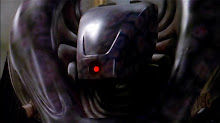
Of course the physical realization of the Horta itself is a cheesy effect, but why should that bother anyone? That said, you can see the fringe of the carpet they're using as part of the creature, which recalls the shambling rug monster of The Creeping Terror, as featured on Mystery Science Theater 3000. As Spock says, "Astonishing that anything of that bulk could move so rapidly."

The legacy of "The Devil of the Dark" rightly lives on in digestible soundbites. The episode itself is a respectable runaround in a series of tunnels, admittedly with a twist that embodies the best of Star Trek. 6/10.

Star Wars: The Clone Wars - The Phantom Apprentice Review

TCW "The Phantom Apprentice"
"The dark side has never been stronger..." - Maul

Driven by an atmosphere of high-octane foreboding, "The Phantom Apprentice" is The Clone Wars at its best. Ahsoka's confrontation with Maul, set against the backdrop of a burning Mandalore, is not only a clash of lightsabers but an insight into Maul's unique perspective on current galactic events. Maul's almost stagey dramatic monologues are sibilantly brought to life by Sam Witwer, while original actor Ray Park performs motion capture for Maul. The choice to utilize Park pays off, as his movements are very noticeably "human". Not to discount the actor performing motion capture for Ahsoka, but Maul's moves are more ostentatious.

Maul elevates villain monologues to an art because of the tragedy of his character: for all his raging ambition, he is trapped by hate and cast aside as a pawn of his master. He sees well enough that truth, that he and Dooku were mere tools for Darth Sidious, as Maul says, "always one step behind". And when Maul says the line quoted up top, it is not with bluster but with a mix of dread and aspiration. We are far away from the silent devil of The Phantom Menace.

With attention to the wider Star Wars story, it is nicely surprising how far into Revenge of the Sith this arc has already overlapped. The episode's climax unfolds more or less in parallel with Obi-Wan's mission to Utapau. With knowledge of Order 66, the imminent rise of the Empire, and Sidious' plans for Anakin, Maul has a familiar proposition for Ahsoka. Just like Vader to Luke, and Kylo Ren to Rey in events yet to come, it's the classic Star Wars "join me". This is part of the appeal of Star Wars: the episode throws new light on events that have been established for years, and stories told in the orbit of the prequel trilogy still have the capacity to surprise.

Canon connections:
- Kevin Kiner uses the Emperor's Theme, the Imperial March, and a motif from Duel of the Fates.
- Excuse me while I freak out that Dryden Vos is in the episode!

A self-consciously dramatic episode, "The Phantom Apprentice" thrillingly dances in the shadow of the wider Star Wars story. 10/10.

Thursday, April 23, 2020

The Twilight Zone Randomized: Number 12 Looks Just Like You

TZ (1959) "Number 12 Looks Just Like You"
In a dystopian society circa 2000 AD, teenagers entering adulthood are pressured by society to accept surgery giving them a traditionally aesthetic body, prefabricated from a limited variety of stock choices. Lead character Marilyn Cuberle (Collin Wilcox, giving off Sissy Spacek energy) is determined not to get the procedure, but her support system's insidious insistence that they know best might erase her free will anyway.

The premise, a clear companion piece to the famous episode "Eye of the Beholder", is a skeleton key that unlocks a lot of fascinating thematic material. The way that catalogued models represent ready-made body templates people can choose to look like comes off as a satire of modern marketing images. "Traditionally beautiful" images have a powerful subconscious effect on self-esteem, and the episode literalizes the impulse to mold oneself on those images.

We see the perspective of adults who have already undergone the procedure. At one point Marilyn's mother comments that the body she chose is "everybody's favorite", which is an oddly arrogant and boastful thing to say. One implication of the technology is that members of families and friend groups can look exactly the same as each other. Again, taking family resemblance to a satirical extreme.

As obviously disastrous as this dystopia is, it throws up complex shadows. For instance, in a world where so many men and women look the same, that might be a world where people must truly rely on their personalities to attract mates. But as the episode goes on, it's clear: the procedure changes how you look, but it also, tragically, smooths out how you think.

And as Marilyn's individual agency is snuffed out, replaced by a boilerplate shell with a blandly docile personality, we realize that while every citizen of this nameless failed utopia may start out with doubts, idiosyncrasies, or violent resistance to homogeny, the state always wins in the end.

While gender-biased pronouns are used throughout, this dystopia holds up. 7/10.

Wednesday, April 22, 2020

Star Trek Randomized Rewatch: A Matter of Perspective

TNG "A Matter of Perspective"
Yes, this is the episode that features the famous Riker facepalm. (Almost as well-known as the Picard facepalm.) It's one of many moments where Riker is made to squirm, as he is accused of the murder of a Tanugan scientist, and must sit through hostile testimony at a hearing. The hook is, the testimony is dramatized on the holodeck, so the prosecution and defense can powerfully and immersively illustrate their sides of the story.

In Tanugan justice, the defendant is guilty until proven innocent, a familiar idea from Cardassian justice later in the franchise, and indeed already seen in this rewatch: It was also the modus operandi of the mid-21st Century courts from the post-atomic horror, as shown in "Encounter at Farpoint". Of course, by episode's end Riker is exonerated, with Picard and Geordi proving his innocence in a very technical, Trekkian way.

From an optics perspective, it should be noted that on the face of it, the episode features a woman (Manua Apgar, the dead scientist's wife) lying about an attempted rape to stack evidence against a man (Riker). While depicting this tends to be a bad look, there is more to it than that. When Manua's testimony is given, Deanna doesn't sense deception from Manua's perspective. So the truth, between a violently exaggerated version of Riker's womanizing tendencies, to Riker's account of warding off her advances, lies somewhere in between. Understanding is a three-edged sword: your side, my side, and the truth.

Ron Jones' score is instantly more interesting than those for the Season 4 and 7 episodes the Randomizer has recently featured. (That's largely because producer Rick Berman wanted the scores toned down about halfway through the show's run.) A regal motif accompanies an amusing scene where Data the art critic assesses the work of Picard's art class (who are painting a nude model). The episode's main theme is waftingly eerie, though admittedly not very pleasant to listen to.

A novel use of the holodeck makes for an engaging look at space justice. 7/10.

Tuesday, April 21, 2020

Star Trek Randomized Rewatch: Inheritance

TNG "Inheritance"
The final season of Star Trek: The Next Generation was like a clown car family reunion. The show debuted Geordi's parents, Worf's foster brother and a future version of his son, Beverly's grandmother, the sister Deanna never knew she had, the son Picard never knew he had, and here, the mother Data never knew he had.

Doctor Juliana Tainer (guest star Fionnula Flanigan) claims to be the wife of Data's creator Noonien Soong, and to have had a hand in crafting Data. Her part in raising Data was, to hear her tell it, erased from Data's memory banks. Data investigates her claims with the same Sherlockian vigor he brings to bear when portraying that detective on the holodeck, and eventually comes to call Juliana mother as casually as he refers to Noonien Soong as his father. (Surely a small sign of Data's progress toward humanity.)

The episode weaves in a wide tapestry of Data continuity from throughout the entire show, with multiple previous episodes mentioned or alluded to. The episode also calls forward to the future, as in retrospect, we can see the seeds planted for Star Trek: Nemesis' B-4 and Star Trek: Picard's Soji and Dahj Asha.

Fionnula Flanagan's warm performance brings out fine work from Brent Spiner as Data, as he processes this new relationship in his own way. Data's wonderfully matter-of-fact affect is on full display, like when he says of his art, "I am attempting to master all known styles of painting."

The twist of the episode comes with the reveal that Juliana is an android replica of the original, long deceased woman, programmed to think herself human and even with some internal human biological systems. She's a clear predecessor of the more "uncannily human" Soong androids Soji and Dahj. One of the highlights of the episode comes in an observation lounge scene where Data, Beverly, Deanna, and Picard discuss whether to tell Juliana if she's an android.

A sweet, above-average character episode for Data and his mother figure. 6/10.

Monday, April 20, 2020

Star Trek Randomized Rewatch: Silent Enemy

ENT "Silent Enemy"
A sickly green-colored alien ship drops out of warp in Enterprise's face, stares it down for a few minutes without responding to hails, then warps away. As Travis puts it, "Maybe they checked us out, decided we weren't that interesting".

The setup is too easy; insert punchline here.

But while encounters with that mysterious craft dominate the main plot of the episode, the subplot also is textually about how uninteresting the regular character Malcolm Reed is.

In a memorably unusual setup for a B-plot, Captain Archer tasks Hoshi with figuring out Malcolm's favorite food. Since Malcolm's birthday is coming up in a couple days, there's a ticking clock. Archer contacts Malcolm's parents on Earth, Hoshi calls his sister and best friend, running into a wall every time. It's a lightweight subplot, amusingly generated basically by how boring Malcolm appears to be. That's one way to develop your characters.

The enigmatic aliens do keep coming back, eventually boarding the ship and skulking around like the aliens in Signs. Their ship tactically outmatches Enterprise, leading Trip and Malcolm to spearhead a project to install phase cannons on the ship. This is all pretty perfunctory stuff, but it succeeds in Enterprise Season 1's mandate to portray Starfleet's origin story. The ship can't even shoot phasers until this episode. Technology later Enterprises take for granted are coming together gradually for the first time. On that point, Archer and Trip have a conversation in the Kirkian "risk is our business" tradition, framing Enterprise as a true pioneer ship.

A functional episode, with a workmanlike A-plot and an entertainingly odd B-plot. 5/10.

Power Rangers Beast Morphers: Boxed in Review

PRBM "Boxed in"
"He's lean, he's mean, he's tougher than two-dollar steak..." - Commentator Gigadrone

The latest episode of Power Rangers is poorly timed. This Beast Morphers sports special revolves around the Pan Global Games, a clear stand-in for the 2020 Tokyo Olympics, which at the time of production were on schedule for this summer. Then COVID-19 happened (and continues to happen).

Whoops.

The episode's status as a cultural artifact aside, it's a decent enough outing infused with some fun silliness, but some deficiencies as well. The plot concerns robot Roxy and Blaze (both chewing the scenery even more than they usually do) unleashing a revolving door of Gigadrones who trap Red Ranger Devon Daniels' Racer Zord in a strange boxing-ring/pocket dimension for a rock 'em sock 'em boxing match.

But that's not before Blue Ranger Ravi Shaw of all people complains that Ranger work is interfering with his attendance of the Games. Ravi should be a by-the-book character, and this development gumbifies his character. The show is in a bit of a bind because it feels like a slightly more appropriate story for, say, Devon from the very beginning of the show, but since he's developed beyond that, it feels like an arbitrary way to include an obligatory message through a randomly chosen character.

Sports infuses the action of the episode, but really only in the flavors of wrestling and boxing. In a fun one-on-one fight, Ravi fights a Robotron (there are so many monsters in this episode it's hard to keep track of the names) with explicitly wrestling-inspired moves, bolstered by his Beast-X super-strength. And when Devon is trapped in the uncanny boxing ring, the action is narrated by a play-by-play Gigadrone who is at first unseen, prompting Devon to say, "There's a Gigadrone and some type of creepy commentator!"

There's a lot of (samey) action between the Racer Zord and a bunch of Gigadrones, and eventually things escalate to the point where the team unlocks the new Beast-X King Ultrazord. Beast Morphers is usually good at having the team genuinely earn a new power-up in a meaningful way, but this isn't one of those times.

Canon connections:
- "Boxed in" was also the title of a Power Rangers Samurai episode, that time punning on a literal physical box.
- At one point during a Tronic fight, you can see concert posters for none other than Ninja Steel Gold Ranger Levi Weston. Wonderful attention to detail.

Not a good showing for Ravi. Some fun gimmicks, but they wear out their welcome fairly quickly. 5/10.